
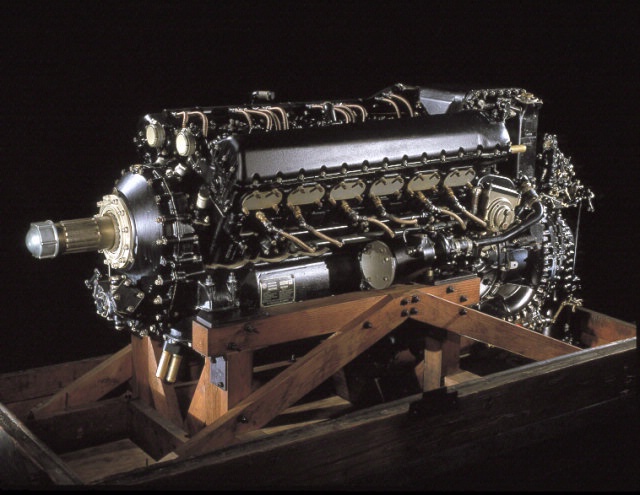
Object Details
Manufacturer
Wright Aeronautical
Physical Description
Type: Reciprocating, 18 cylinders, 2 rows, radial, air-cooled
Power rating: 1,491 kW (2,000 hp) at 2,400 rpm
Displacement: 54.9 L (3,350 cu in)
Bore and Stroke: 156 mm (6.1 in.) x 160 mm (6.3 in.)
Weight: 1,239 kg (2,731 lb)
Summary
This was among the largest piston engines ever successfully produced. Design began in early-1936, and the first engine ran in mid-1937. Development and early application was particularly troubled by catastrophic backfires. The major airframe application of the Wright R-3350 engine was during World War II on the Boeing B-29.
The engine continued to give useful service after the war, one version of which was the first of its type to have its exhaust turbines (3 of them) geared into the power system. Called the Wright Turbo-Compound Cyclone, it was the last and the most highly developed piston engine to be widely used in large military and commercial airplanes. Airline application was in the Douglas DC-7 and Lockheed Super Constellation.
Only two R-3350-14 engines were built, and those were for the Douglas XSB2D-1 and B2D-1.
Credit Line
Transferred from the U.S. Navy, Naval Supply Center, Cheatham Annex, Williamsburg, Virginia
Date
Circa 1941
Inventory Number
A19731564000
Restrictions & Rights
Usage conditions apply
Type
PROPULSION-Reciprocating & Rotary
Materials
Non-Magnetic White Metal
Ferrous Alloy
Rubber
Paint
Wood
Unknown Coating
Anodized Aluminum
Copper Alloy
Adhesive Tape
Dimensions
Diameter 137.5 cm (54.12 in.), Length 197.6 cm (77.8 in.)
Country of Origin
United States of America
See more items in
National Air and Space Museum Collection
Data Source
National Air and Space Museum
Link to Original Record
Record ID
nasm_A19731564000