
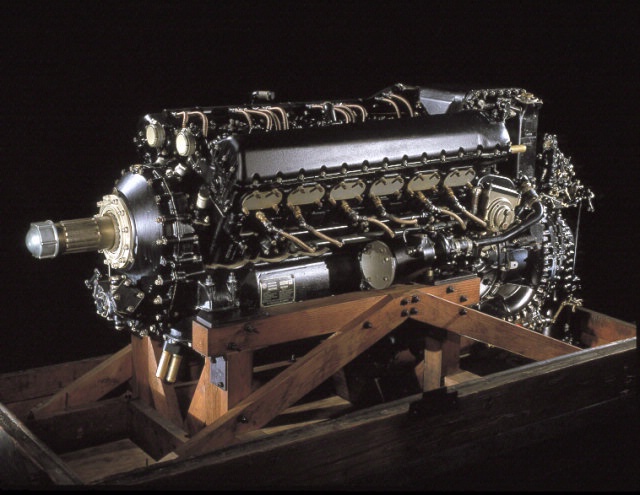
Object Details
Manufacturer
Wright Aeronautical
Physical Description
Type: Reciprocating, 9 cylinders, radial, air-cooled
Power rating: 391 kW (525 hp) at 1,900 rpm
Displacement: 30.5 L (1,750 cu in.)
Bore and Stroke: 171 mm (6.8 in.) x 152 mm (6.0 in.)
Weight: 345 kg (760 lb)
Summary
Following the departure of Frederick Rentschler and colleagues to form Pratt & Whitney, Charles Lawrance, who formerly headed his own company, became president of Wright Aeronautical, and reacted vigorously with a competitor to Pratt & Whitney’s Hornet. An enlarged and improved Wright Cyclone engine, known as the Model R-1750, made its formal appearance and passed a 50-hour service test during 1927, succeeding the Cyclone P-2, and certificated in January 1929. This model was relatively short lived, and was replaced by the more heavily produced R-1820 beginning in 1930.
Aircraft powered by R-1750, GR-1750, G1R-1750, and R-1750E engines included the: Keystone XLB-6, LB-6, LB-9, LB-10, LB-11, LB-11A, B-5A; Thomas-Morse XO-21A; Douglas O-29; General Avia C-14 and C-15.
Credit Line
Found in the collection
Date
1929
Inventory Number
A19660457000
Restrictions & Rights
Usage conditions apply
Type
PROPULSION-Reciprocating & Rotary
Materials
HAZ MAT: Asbestos
Ferrous Alloy
Aluminum Alloy
Paint
Adhesive Tape
Rubber
Grease
Plastic
Silica Gel
Copper Alloy
Dimensions
3-D: 88.9 × 139.7cm, 344.7kg (2 ft. 11 in. × 4 ft. 7 in., 760lb.)
Country of Origin
United States of America
See more items in
National Air and Space Museum Collection
Data Source
National Air and Space Museum
Link to Original Record
Record ID
nasm_A19660457000