
Object Details
Manufacturer
Wright Aeronautical
Physical Description
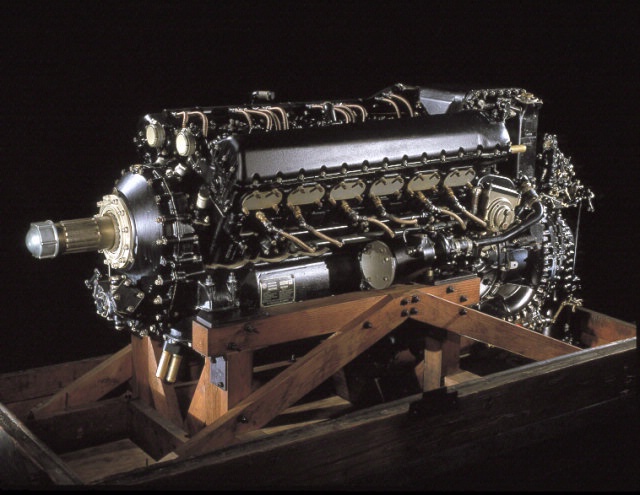
Type: Reciprocating, 18 cylinders, 2-rows, geared, radial, air-cooled
Power rating: 1,641 kW (2,200 hp) at 2,800 rpm
Displacement: 54.9 L (3,347 cu in.)
Bore and Stroke: 156 mm (6.125 in.) x 160 mm (6.3125 in.)
Weight: 1,211 kg (2,670 lb)
Summary
The major airframe application of the Wright R-3350 was the Boeing B-29 during World War II. Rushed into service, the engine had many difficulties, initially resulting in many losses from engine fires on takeoff. Typified by this version used in later B 29s such as the Enola Gay, also displayed at the museum, the problem was eventually solved with improvements including replacement of the carburetors with fuel injectors.
The engine was also used on the Martin PB2M Mars flying boat, and other models continued to serve in commercial aviation long after the war. One version was the first of its type to have its exhaust turbines (three of them) geared into the power system. Called the Wright Turbo-Compound Cyclone, it was the last and the most highly developed piston engine to be widely used in large military and commercial airplanes, including the Douglas DC-7 and Lockheed Super Constellation.
Credit Line
Found in the collection
Date
1941
Inventory Number
A19670013000
Restrictions & Rights
Usage conditions apply
Type
PROPULSION-Reciprocating & Rotary
Dimensions
Diameter: 141.7 cm (55.78 in.), Length: 193.7 cm (76.26 in.)
Country of Origin
United States of America
See more items in
National Air and Space Museum Collection
Location
Steven F. Udvar-Hazy Center in Chantilly, VA
Hangar
Boeing Aviation Hangar
Data Source
National Air and Space Museum
Link to Original Record
Record ID
nasm_A19670013000