Object Details
Manufacturer
Wright Company (Dayton, Ohio)
Physical Description
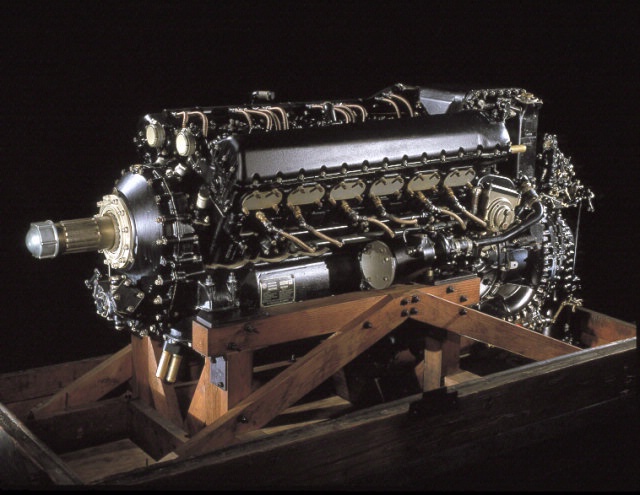
Type: Reciprocating, in-line, 6 cylinders, water-cooled
Power rating: 52 kW (70 hp) at 1,400 rpm
Displacement: 6.64 L (405 cu in)
Bore and Stroke: 11.113 cm (4.375 in) x 11.430 cm (4.500 in)
Weight (wet): 159 kg (350 lb)
Summary
The original Wright brothers engines were vertical, four cylinder types. In 1910, needing a more powerful engine for the Gordon Bennett Cup Race, a single V-8 was built for this major event, apparently using much of the original four cylinder design concept. However, the aircraft and engine were wrecked before the race.
Faced with the problem of providing increased power for production aircraft in 1911, but insisting on their original objective of simplicity, the Wright’s compromise was a vertical six-cylinder engine. The engine incorporated a flexible (rubber band) drive on the flywheel which greatly reduced vibration and considerably extended the life of the chain drive that operated the propellers. The Wright 6-70 powered the Wright Model D aircraft in 1913, and the model designation was derived from the number of cylinders and the horsepower. Originating as a 45 kW (60 hp) model, further development led to a 60 kW (80 hp) version.
Credit Line
Transferred from the Department of the Navy, Bureau of Aeronautics
Date
Circa 1913
Inventory Number
A19520103000
Restrictions & Rights
CC0
Type
PROPULSION-Reciprocating & Rotary
Materials
Metal
Dimensions
3-D: 114.3 × 38.1 × 78.7cm (45 × 15 × 31 in.)
Support: 62.9 × 100.3 × 52.1cm (24 3/4 in. × 39 1/2 in. × 20 1/2 in.)
Country of Origin
United States of America
See more items in
National Air and Space Museum Collection
Location
National Air and Space Museum in Washington, DC
Exhibition
Early Flight
Data Source
National Air and Space Museum
Link to Original Record
Record ID
nasm_A19520103000