
Object Details
Manufacturer
Aviation Gas Turbine Div., Westinghouse Electric Corp., Philadelphia, PA
Physical Description
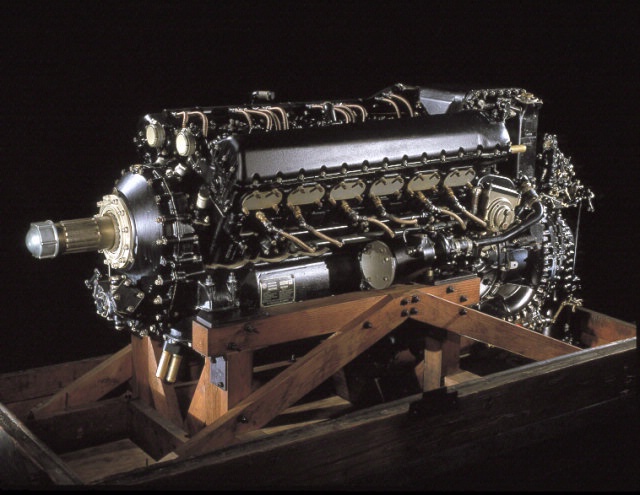
Type: Turbojet
Thrust: 26,022 N (5,850 lb) at 10,100 rpm
Compressor: 12-stage axial
Combustor: One single annular with walking stick evaporators
Turbine: 2-stage axial
Weight: 948 kg (2,090 lb) with afterburner installed
Summary
In response to the Special Committee on Jet Propulsion of the National Advisory Committee for Aeronautics, the Westinghouse Research Laboratories proposed development of a turbojet engine, but started development without a contract. The 4,893 N (1,100 lb) thrust 19A Yankee (military designation J30), the first all-American-designed turbojet engine flew on a Chance Vought FG-1 Corsair testbed aircraft in 1944 in its original function as a booster engine.
In succession, the Westinghouse J46, with a thrust of 22,240 N (5,000 lb) without afterburner, was planned as a replacement for the Westinghouse J34. With three bearings instead of two, as had the J40, it passed the 150 hour qualification test in 1953. It only had limited production, primarily for the Vought F7U Cutlass.
With afterburner, the J46-WE-8 powered the Chance Vought A2U-1 and F7U-3 Cutlass as well as the Convair XF2Y-1 Sea Dart. This J46-WE-8 was accepted for service in 1955 and was installed in a Chance Vought F7U-3M aircraft.
Credit Line
Transferred from the U.S. Navy
Date
1955
Inventory Number
A19710911000
Restrictions & Rights
Usage conditions apply
Type
PROPULSION-Turbines (Jet)
Dimensions
Overall: 37 x 38 x 182in., 2090lb. (94 x 96.5 x 462.3cm, 948kg)
Other: 37 x 182 x 38in. (94 x 462.3 x 96.5cm)
Country of Origin
United States of America
See more items in
National Air and Space Museum Collection
Data Source
National Air and Space Museum
Link to Original Record
Record ID
nasm_A19710911000