
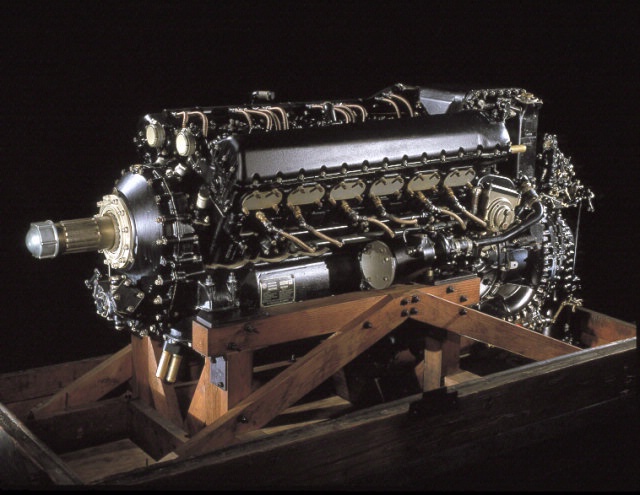
Object Details
Manufacturer
Aviation Gas Turbine Div., Westinghouse Electric Corp., Philadelphia, PA
Physical Description
Type: Turbojet
Thrust: 46,704 N (10,500 lb) at 7,600 rpm
Compressor: 10-stage axial
Combustor: Annular combustion chamber
Turbine: 2-stage axial
Weight: 1,588 kg (3,500 lb)
Summary
Following World War II, the Navy decided to develop a turbojet with improved fuel consumption at high altitudes, with emphasis on large single-engine craft. Westinghouse initiated the J40 development program in 1947, and the first flight took place in 1951 when it powered the McDonnell XF3H-1 Demon on its maiden flight. At that time, the J40 was the most powerful U.S. turbojet engine qualified for production.
In 1953, the Douglas XF4D-1 Skyray powered by a J40-WE-8 engine with afterburner established a new World's Speed Record of 1,205 km/hr (753.4 mph). The J40-WE-6/-8 powered the two prototype Skyrays, but development delays resulted in the aircraft going into production with the Pratt & Whitney J57. The J40 was not produced in quantity as a result of insufficient thrust for its intended airframe applications, critical problems and schedule delays, and because other more powerful competitor engines were available.
This artifact powered the Grumman F10F-1 Jaguar and the Douglas XF4D-1 Skyray aircraft.
Credit Line
Transferred from the U.S. Navy, Naval Supply Center, Cheatham Annex, Williamsburg, Virginia.
Date
1953
Inventory Number
A19731558000
Restrictions & Rights
Usage conditions apply
Type
PROPULSION-Turbines (Jet)
Dimensions
Overall: 3500lb. (1587.6kg)
Other: 25 ft. × 3 ft. 4 in. (762 × 101.6cm)
Storage: 134.6 × 535.9 × 144.8cm (4 ft. 5 in. × 17 ft. 7 in. × 4 ft. 9 in.)
Country of Origin
United States of America
See more items in
National Air and Space Museum Collection
Data Source
National Air and Space Museum
Link to Original Record
Record ID
nasm_A19731558000