
Object Details
Designer
W. O. Warner
Manufacturer
Warner Aircraft Corporation
Physical Description
Type: Reciprocating, 7 cylinders, radial, air cooled
Power rating: 82 kW (110 hp) at 1,850 rpm
Displacement: 6.92 L (422 cu in.)
Bore and Stroke: 108 mm (4.25 in.) x 108 mm (4.25 in.)
Weight: 124.7 kg (275 lb)
Summary
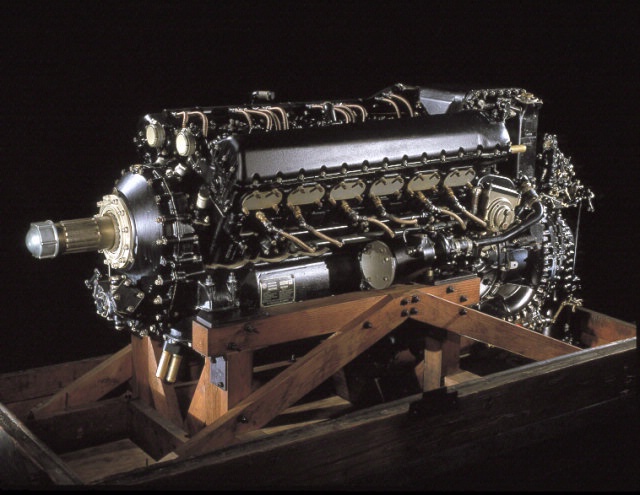
Warner Aircraft built four models of radial, air-cooled engines. Three were seven cylinder engines known as the “Scarab,” “Super-Scarab,” and “Super-Scarab 165.” The Scarab was introduced in 1928 as a replacement for the surplus World War I-era Curtiss OX 5 engines that dominated the small, moderately priced aircraft market in the late 1920s. The new engine was successful in aerial contests across the country, including the 1930 National Air Races in Chicago, where Scarab-powered aircraft placed first in 14 events. The Monocoupe 110, Cessna AW, Stinson Junior SM-2, Travel Air W-4000, Fairchild 24 C8A, and Mohawk Pinto M-1-CW all used the Scarab.
This Scarab artifact powered the Ingalls/Alfaro X-13 cabin monoplane. David S. Ingalls entered the Heraclio Alfaro-designed airplane in the Guggenheim Safe Aircraft Competition of 1927-29, which encouraged the use of new technologies, such as high-lift devices, to improve the safe handling characteristics of aircraft.
Credit Line
Gift of Charles Woerner
Date
1928
Inventory Number
A19550077000
Restrictions & Rights
Usage conditions apply
Type
PROPULSION-Reciprocating & Rotary
Dimensions
Diameter 90.2 cm (35.5 in.), Length 73.7 cm (29 in.) (without starter) (1928 series)
Country of Origin
United States of America
See more items in
National Air and Space Museum Collection
Location
Steven F. Udvar-Hazy Center in Chantilly, VA
Hangar
Boeing Aviation Hangar
Data Source
National Air and Space Museum
Link to Original Record
Record ID
nasm_A19550077000