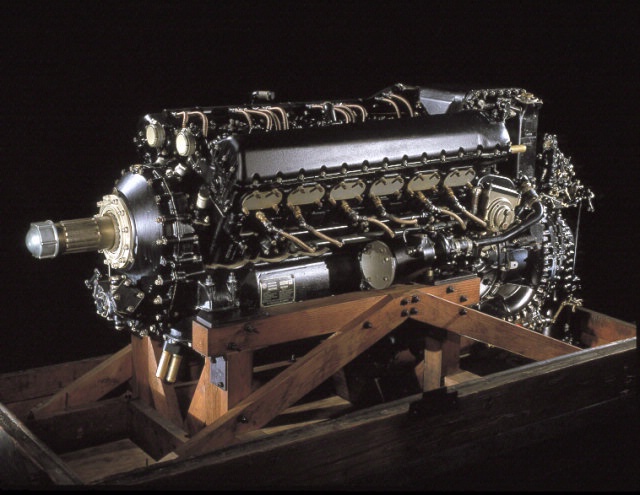
Object Details
Manufacturer
John Stringfellow
Physical Description
Type: Reciprocating, steam, single cylinder, alcohol fuel
Power rating: 0.813 kW (1.1 hp) at 445 N (100 lb) boiler pressure, 300 rpm
Displacement: 0.15 L (9.42 cu in.)
Bore and Stroke: 5.1 cm (2 in.) x 7.6 cm (3 in.)
Weight: 5.9 kg (13 lb)
Summary
Like the Wright brothers, who followed, John Stringfellow and his associate William Henson are an important link to early aeronautical researchers. At an exposition in 1868 in London's Crystal Palace, where it powered a triplane model along a cable, the Aeronautical Society of Great Britain awarded a prize of £100 to Stringfellow’s engine as the lightest in proportion to its power, producing 0.75 kW (one horsepower) for the weight of 5.9 kg (13 pounds).
In 1889, Smithsonian Secretary Samuel P. Langley purchased the engine, along with a "car" designed to carry an engine and a pair of propellers, for £25. Langley held on to the engine briefly, sending it to L.D. Copeland of Smithville, N.J., for experimental work. Upon return of the engine to Langley, he turned it over to the museum section of the Smithsonian for public display, also in 1889.
Credit Line
Purchased from Frederick J. Stringfellow
Date
1868
Inventory Number
A18890001000
Restrictions & Rights
CC0
Type
PROPULSION-Reciprocating & Rotary
Materials
Metal
Copper alloy
Steel
Cotton
Wood
Paint
Clear coating
Dimensions
3-D: 60.5 × 12.8 × 60.2cm (23 13/16 × 5 1/16 × 23 11/16 in.)
Country of Origin
United Kingdom
See more items in
National Air and Space Museum Collection
Location
National Air and Space Museum in Washington, DC
Exhibition
Early Flight
Data Source
National Air and Space Museum
Link to Original Record
Record ID
nasm_A18890001000