Skip to main content Skip to main navigation
heart-solid My Visit Donate
Home Smithsonian Institution IK development site for ODI
Press Enter to activate a submenu, down arrow to access the items and Escape to close the submenu.
    • Overview
    • Museums and Zoo
    • Entry and Guidelines
    • Museum Maps
    • Dine and Shop
    • Accessibility
    • Visiting with Kids
    • Group Visits
    • Overview
    • Exhibitions
    • Online Events
    • All Events
    • IMAX & Planetarium
    • Overview
    • Topics
    • Collections
    • Research Resources
    • Stories
    • Podcasts
    • Overview
    • For Caregivers
    • For Educators
    • For Students
    • For Academics
    • For Lifelong Learners
    • Overview
    • Become a Member
    • Renew Membership
    • Make a Gift
    • Volunteer
    • Overview
    • Our Organization
    • Our Leadership
    • Reports and Plans
    • Newsdesk
heart-solid My Visit Donate

Spacecraft, Mariner 10, Flight Spare

Air and Space Museum

This media is in the public domain (free of copyright restrictions). You can copy, modify, and distribute this work without contacting the Smithsonian. For more information, visit the Smithsonian's Open Access page.
International media Interoperability Framework
IIIF provides researchers rich metadata and media viewing options for comparison of works across cultural heritage collections. Visit the IIIF page to learn more.
View manifest View in Mirador Viewer
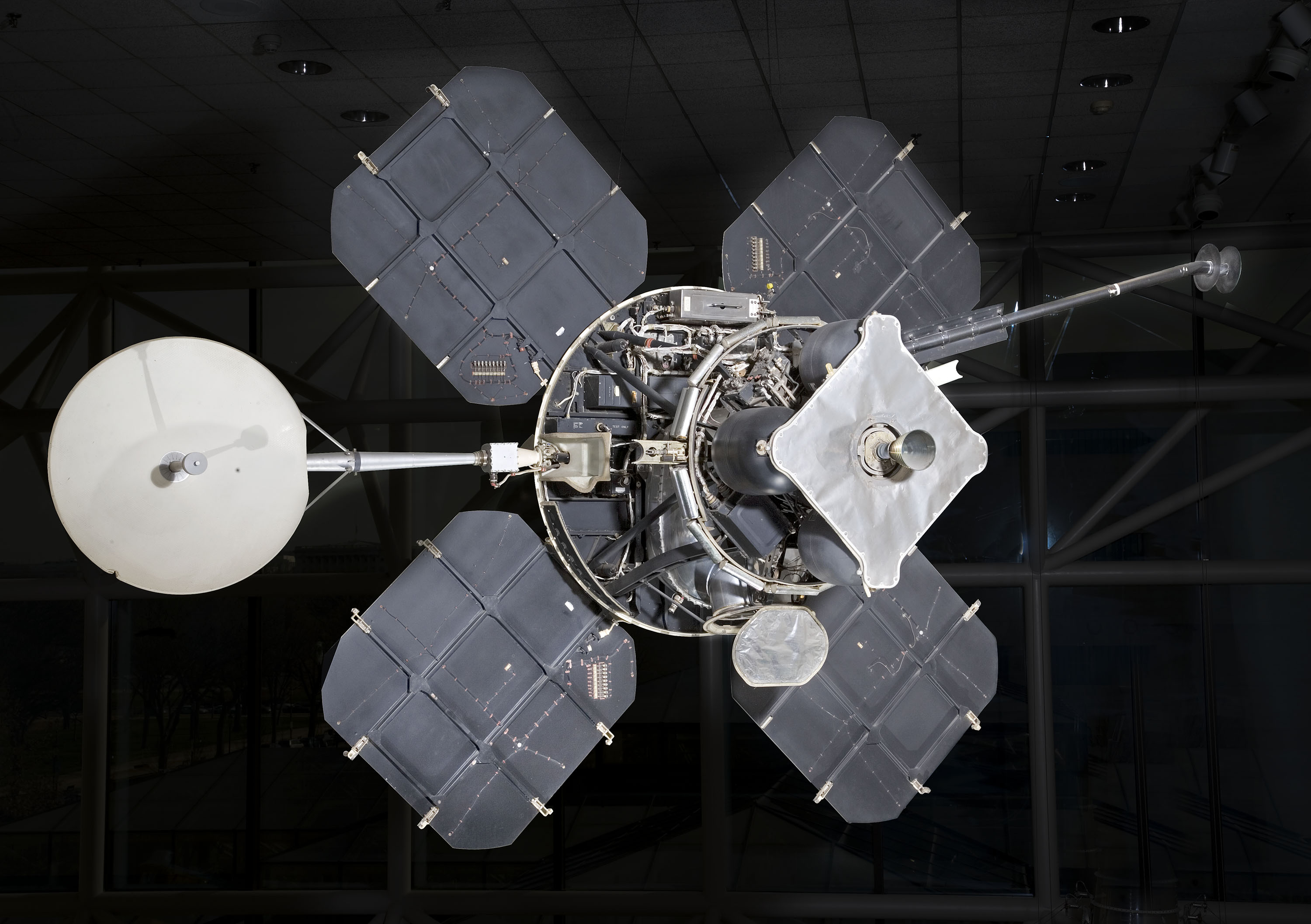
  • Mariner 10 Spacecraft made out of aluminum, and mixed metals.
  • Octagonal white framework with a sunshade at the bottom, an antenna and white parabolic reflector in front. Two tiltable solar panels fan out at the sides.

    Object Details

    Manufacturer

    Boeing Aerospace Company

    Summary

    Mariner 10 was the seventh successful launch in the Mariner series and the first spacecraft to use the gravitational pull of one planet (Venus) to reach another (Mercury). It was also the first probe to visit two planets. Launched on November 3, 1973, it reached Venus on February 5, 1974. Using a gravity assist from this planet, Mariner 10 first crossed the orbit of Mercury on March 29, 1974 and did so a second time on September 21, 1974. A third and last Mercury encounter took place on March 16, 1975. It measured the environments of both Venus and Mercury. It then undertook experiments in the interplanetary medium. Mariner 10 showed that Venus had at best a weak magnetic field, and the ionosphere interacted with the solar wind to form a bow shock. At Mercury, it confirmed that Mercury had no atmosphere and a cratered, dormant Moon-like surface.
    This flight spare was transferred from NASA, Jet Propulsion Laboratory to the Museum in 1982.

    Alternate Name

    Mariner 10

    Key Accomplishment(s)

    First Spacecraft to Use Gravity Assist

    Brief Description

    Mariner 10 was the first spacecraft to use the gravitational pull of one planet to reach another and the first probe to visit two planets. Launched November 3, 1973, it reached Venus on February 5, 1974. Using gravity assist, it went on to fly by Mercury.

    Credit Line

    Transferred from the National Aeronautics and Space Administration

    Inventory Number

    A19830006000

    Restrictions & Rights

    CC0

    Type

    SPACECRAFT-Uncrewed-Communications

    Materials

    Aluminum, mixed metals

    Dimensions

    Overall: 6 ft. tall x 6 ft. wide x 6 ft. deep (182.88 x 182.88 x 182.88cm)
    Other (magnetometer boom): 20 ft. long (609.6cm)

    Country of Origin

    United States of America

    See more items in

    National Air and Space Museum Collection

    Location

    National Air and Space Museum in Washington, DC

    Exhibition

    Kenneth C. Griffin Exploring the Planets Gallery

    Data Source

    National Air and Space Museum

    Metadata Usage

    CC0

    Link to Original Record

    http://n2t.net/ark:/65665/nv9ed15a631-e765-48d2-8456-b21bb3ea9fc5

    Record ID

    nasm_A19830006000

    Discover More

    A painting showing a fictional depiction of rockets on the surface of mars.

    Kenneth C. Griffin Exploring the Planets Gallery

    Lunar orbiter on display

    Space Science

    sign saying Sorry! Last car in this line

    1973: A Year in the Collections

    Lunar orbiter on display

    Space Science

    arrow-up Back to top
    Home
    • Facebook facebook
    • Instagram instagram
    • LinkedIn linkedin
    • YouTube youtube

    • Contact Us
    • Get Involved
    • Shop Online
    • Job Opportunities
    • Equal Opportunity
    • Inspector General
    • Records Requests
    • Accessibility
    • Host Your Event
    • Press Room
    • Privacy
    • Terms of Use