
Object Details
Manufacturer
RCA Astro Electronics
Summary
In the 1970s, NASA inaugurated the Landsat series of satellites to study the Earth from space. The program demonstrated the practical benefits of such research: for the first time the Earth's natural resources--land, water, and vegetation--could be mapped and studied continuously and on a global basis.
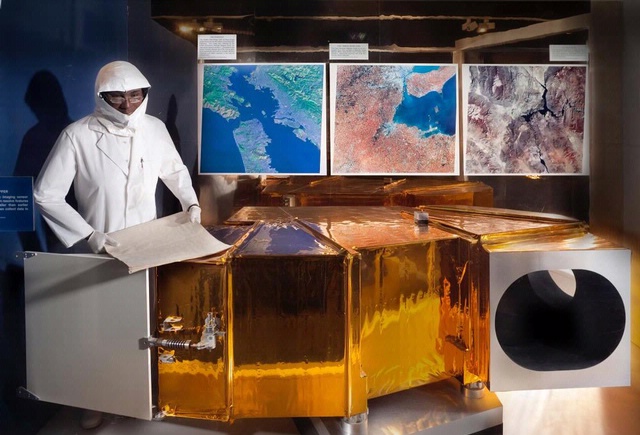
The Earth Resources Technology Satellite (later renamed Landsat 1), launched in 1972, was the first of these satellites. One of the main instruments was a Return Beam Vidicon (RBV) camera, which provided provided black and white images of the Earth.
This artifact, a vidicon (or television) tube, was the key component of this instrument system. The RBV used three vidicon tubes, each gathering data at different wavelengths.
Mr. Abe Schapf donated this artifact to the Museum in 1975.
Credit Line
Gift of Abe Schapf
Inventory Number
A19761829000
Restrictions & Rights
Usage conditions apply
Type
SPACECRAFT-Uncrewed-Instruments & Payloads
Materials
Glass, ferrous alloy, white metal alloy, copper alloy, unidentified plastics, paint, black ink
Dimensions
3-D: 21.3 × 5.7cm (8 3/8 × 2 1/4 in.)
3-D: 0.2kg (0.4lb.)
Country of Origin
United States of America
See more items in
National Air and Space Museum Collection
Location
National Air and Space Museum in Washington, DC
Exhibition
One World Connected
Data Source
National Air and Space Museum
Link to Original Record
Record ID
nasm_A19761829000