
Object Details
Manufacturer
American Science & Engineering, Incorporated
Johns Hopkins University, Applied Physics Laboratory
Summary
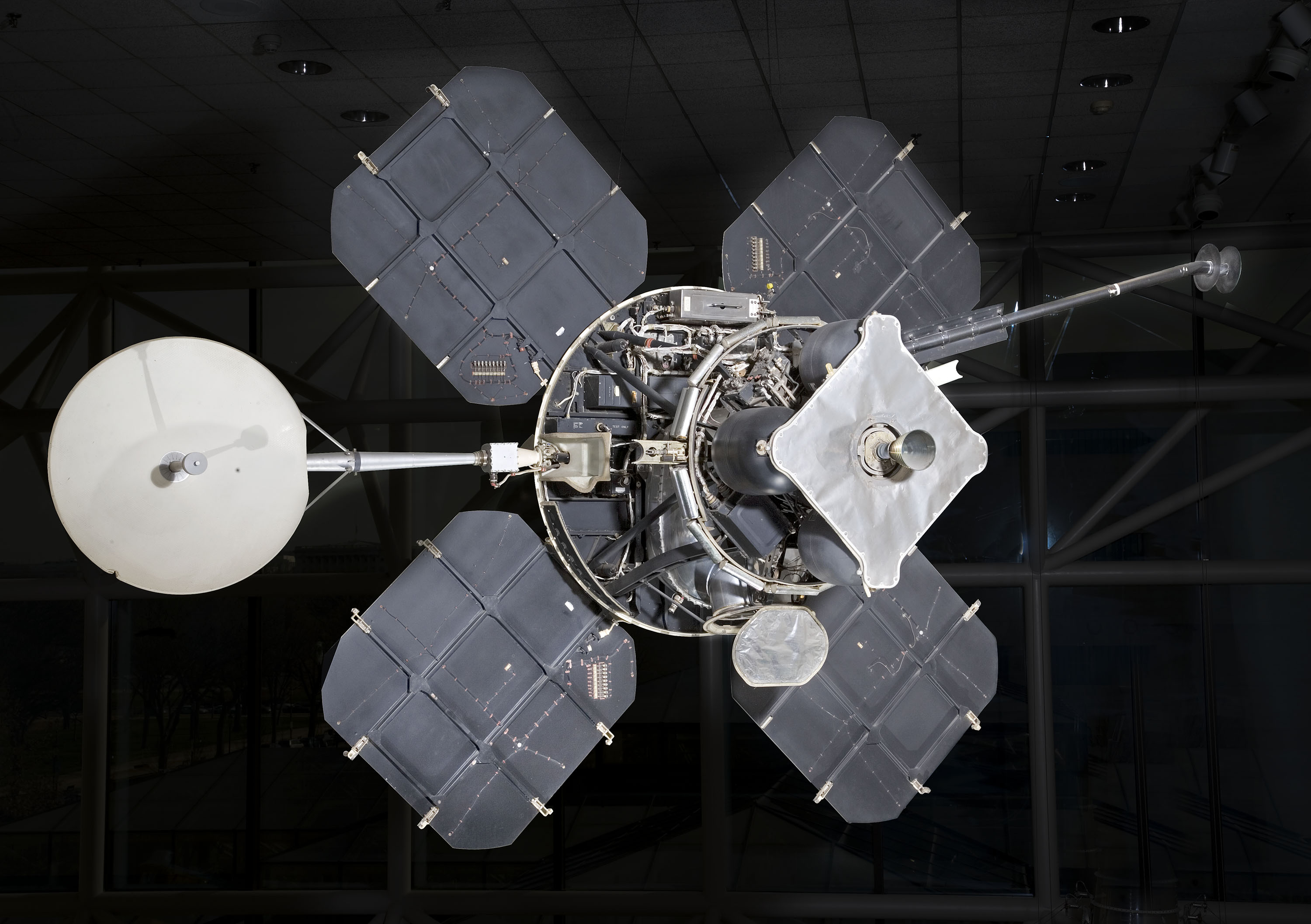
This is a rebuilt engineering prototype of the first Small Astronomy Satellite, or SAS - 1. SAS-1 was devoted exclusively to the study of non-solar x-rays in space. It was launched by an international team from a platform off the coast of Kenya on December 12, 1970. It was named Uhuru, meaning freedom in Swahili, to mark the fact that the date represented the 7th anniversary of Kenyan independence. Uhuru scanned the x-ray sky using two collimated x-ray telescopes pointing in opposite directions. In its three years of operation it mapped more than 200 x-ray sources and provided early evidence for the existence of black holes as well as a binary x-ray source. The components were originally operational except for the solar panels that are non-operational imitations. Transferred from NASA in 1976, the artifact was displayed in the "Satellites" Gallery from 1976 to 1982 and then in the "Stars" gallery from 1983 through 1997. It was restored in 1998 (one of the star sensors was dented while it was on display).
Credit Line
Gift of Johns Hopkins University
Inventory Number
A19761823000
Restrictions & Rights
Usage conditions apply
Type
SPACECRAFT-Uncrewed
Materials
Metal partly covered with metallic foil.
Dimensions
Overall (excludes solar panels and antennae): 26 in. tall x 20 1/16 in. in. wide (66 x 51cm)
Country of Origin
United States of America
See more items in
National Air and Space Museum Collection
Data Source
National Air and Space Museum
Link to Original Record
Record ID
nasm_A19761823000