
Object Details
Summary
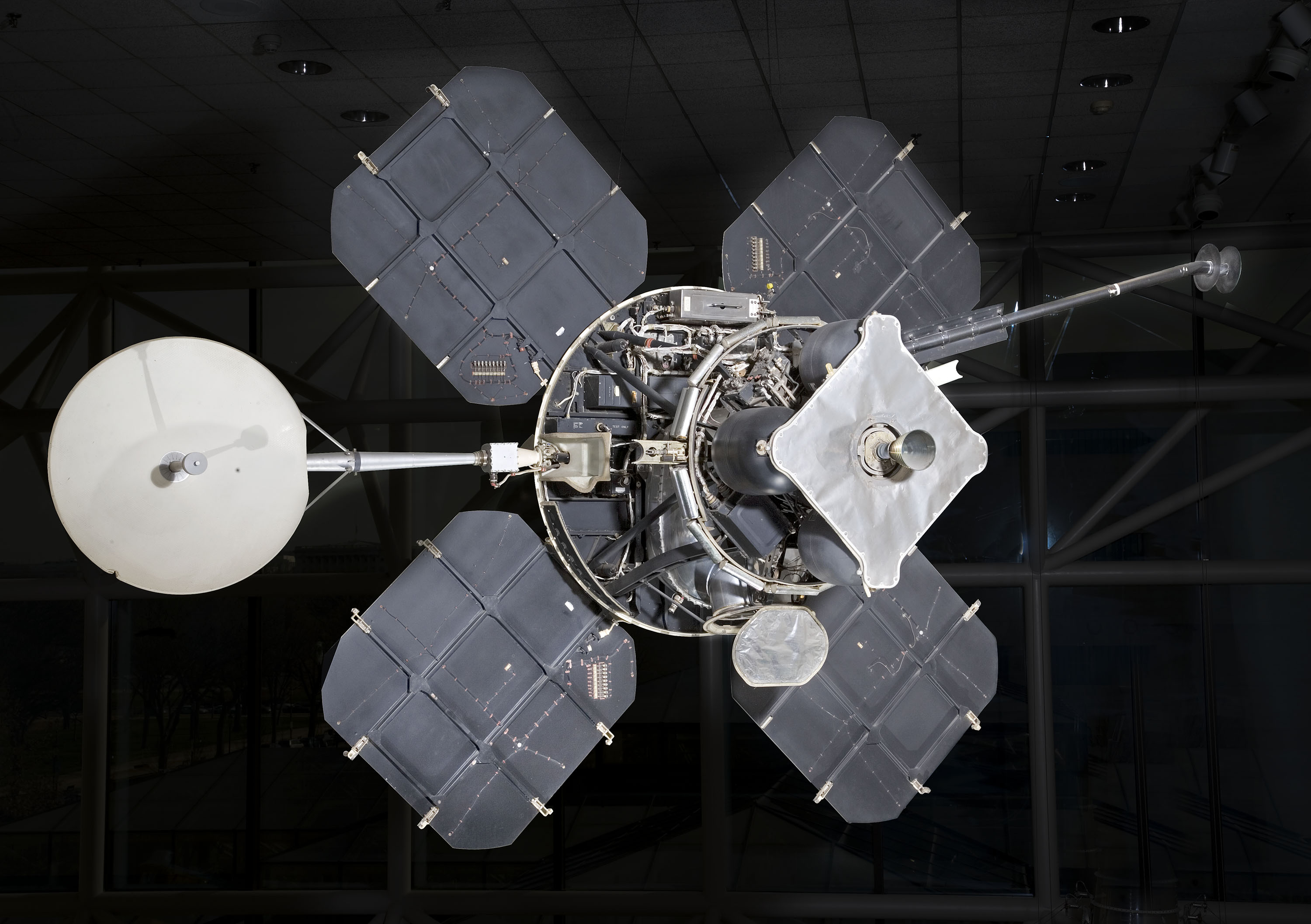
This is a 1/20th scale model of the Pegasus A satellite, a spacecraft that consisted of a very large wing-like micro-meteoroid detector connected to a central instrument bus. It was placed in orbit on a Saturn (S-1 and S-IV stages) vehicle on 16 February 1965. Once in orbit, the 14-foot wide, 96-foot long array of detector panels was deployed by a combination of springs and a scissors jack-like linkage driven by electric motors. Operation of the array of flat plate capacitors constructed out of polyurethane foam core with an aluminum-mylar-copper laminated skin, was only partly successful. The spacecraft was still providing some data as late as 1980. Pegasus I was the first of two satellites designed to provide data on the intensity and direction of meteoroid bombardment in near-Earth orbit.
The model was transferred to NASM by NASA, Marshall Space Flight Center in May 1974.
Credit Line
Transferred from the National Aeronautics and Space Administration
Inventory Number
A19750182000
Restrictions & Rights
Usage conditions apply
Type
MODELS-Uncrewed Spacecraft & Parts
Materials
Base - Wood Satellite: plastic and metal, adhesive, paint
Dimensions
Overall: 8in. x 4ft 6in. x 4in. (20.32 x 137.16 x 10.2cm)
Country of Origin
United States of America
See more items in
National Air and Space Museum Collection
Data Source
National Air and Space Museum
Link to Original Record
Record ID
nasm_A19750182000