
Object Details
Manufacturer
Naval Research Laboratory
Summary
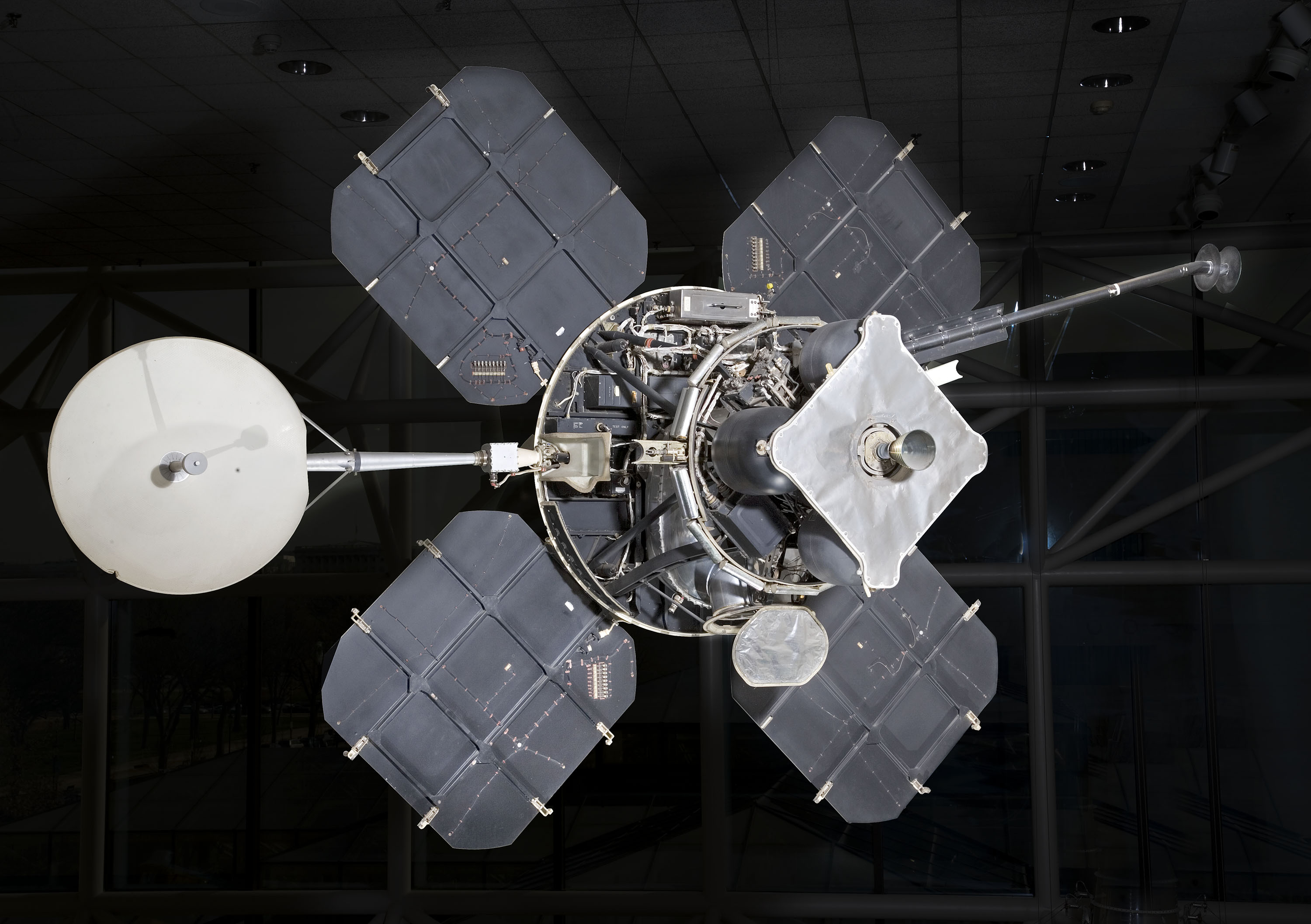
Engineering model for the first of a series of LOw Frequency Trans-Ionospheric (LOFTI) radio satellites. LOFTI satellites were one of the very early orbiting spacecraft intended to study the propagation of radio waves through and by the ionosphere. The experiment was also designed to determine whether low frequency radio signals penetrated water reliably enough to be used for communications with submerged submarines. The first in the series, LOFTI-1 was launched on a Thor-Able rocket in 1961; the scheduled separation from the Transit-3B satellite to which it was attached failed. Much valuable data on VLF and VHF transionospheric transmission was obtained in spite of the satellite's resulting shortened time in orbit. This artifact was transferred to NASM from the U. S. Naval Research Laboratory in 1975.
Alternate Name
LOFTI-I satellite
Credit Line
Transferred from the Naval Research Laboratory
Inventory Number
A19760022000
Restrictions & Rights
Usage conditions apply
Type
SPACECRAFT-Uncrewed
Materials
Polished aluminum sphere, solar arrays
Dimensions
Overall: 1 ft. 8 in. wide, 18 lb. (50.8cm, 8.2kg)
Other (antennae): 3 ft. long (91.44cm)
Country of Origin
United States of America
See more items in
National Air and Space Museum Collection
Location
Steven F. Udvar-Hazy Center in Chantilly, VA
Exhibit Station
Space Science
Data Source
National Air and Space Museum
Link to Original Record
Record ID
nasm_A19760022000