
Object Details
Manufacturer
NASA, Goddard Space Flight Center
Summary
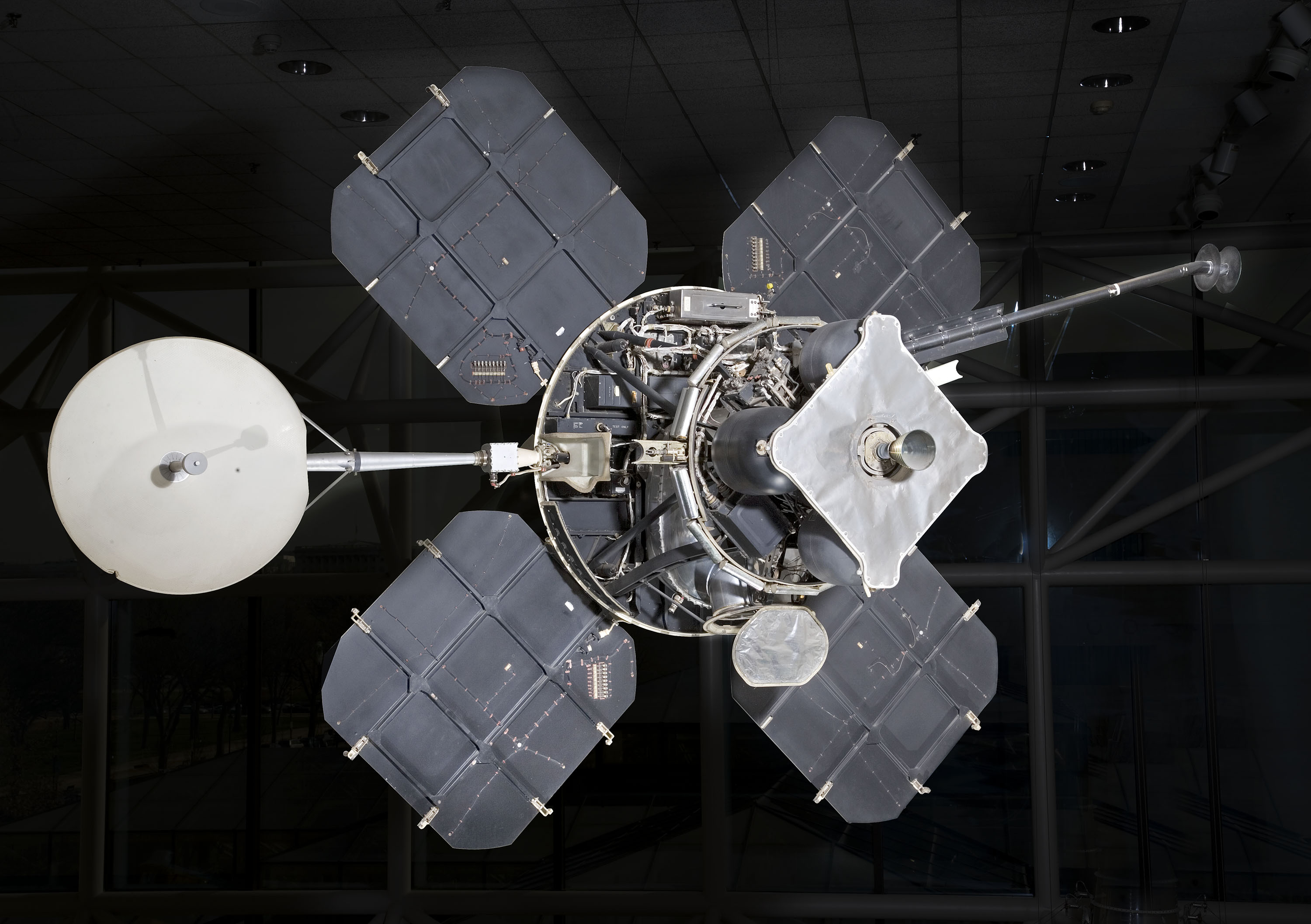
This is the engineering model for the Interplanetary Monitoring Platform A (IMP-A or Explorer 18). It is the first of a series of seven satellites designed to be launched before and during Apollo flights. IMP-A carried instruments designed to measure cosmic rays, the solar wind, and interplanetary magnetic fields beyond the earth's magnetic field. The sphere on top of the boom contained a sensitive magnetometer. Four windmill-like solar panels provided operating power. The satellite was launched on November 26, 1963 aboard a Delta vehicle resulting in a highly elliptical orbit that ranged from 110 to 122,800 miles. Data from the mission led to the discovery of a new layer of radiation beyond the Van Allen belt and confirmed the existence of a standing shock wave in the solar wind around the earth's magnetic field. This object was transferred to NASM by NASA in May 1976.
Alternate Name
IMP-A satellite
Credit Line
Transferred from the National Aeronautics and Space Administration
Inventory Number
A19761835000
Restrictions & Rights
Usage conditions apply
Type
SPACECRAFT-Uncrewed
Materials
Mixed metals, solar cells, electronics
Dimensions
Overall: 4 ft. 5 in. tall x 2 ft. 5 in. wide x 1 ft. 1 in. diameter, 75 lb. (134.62 x 73.66 x 33.02cm, 34kg)
Country of Origin
United States of America
See more items in
National Air and Space Museum Collection
Location
Steven F. Udvar-Hazy Center in Chantilly, VA
Exhibit Station
Space Science
Data Source
National Air and Space Museum
Link to Original Record
Record ID
nasm_A19761835000