
Object Details
Manufacturer
Jet Propulsion Laboratory, California Institute of Technology
U.S. Army Ballistic Missile Agency, Redstone Arsenal
Summary
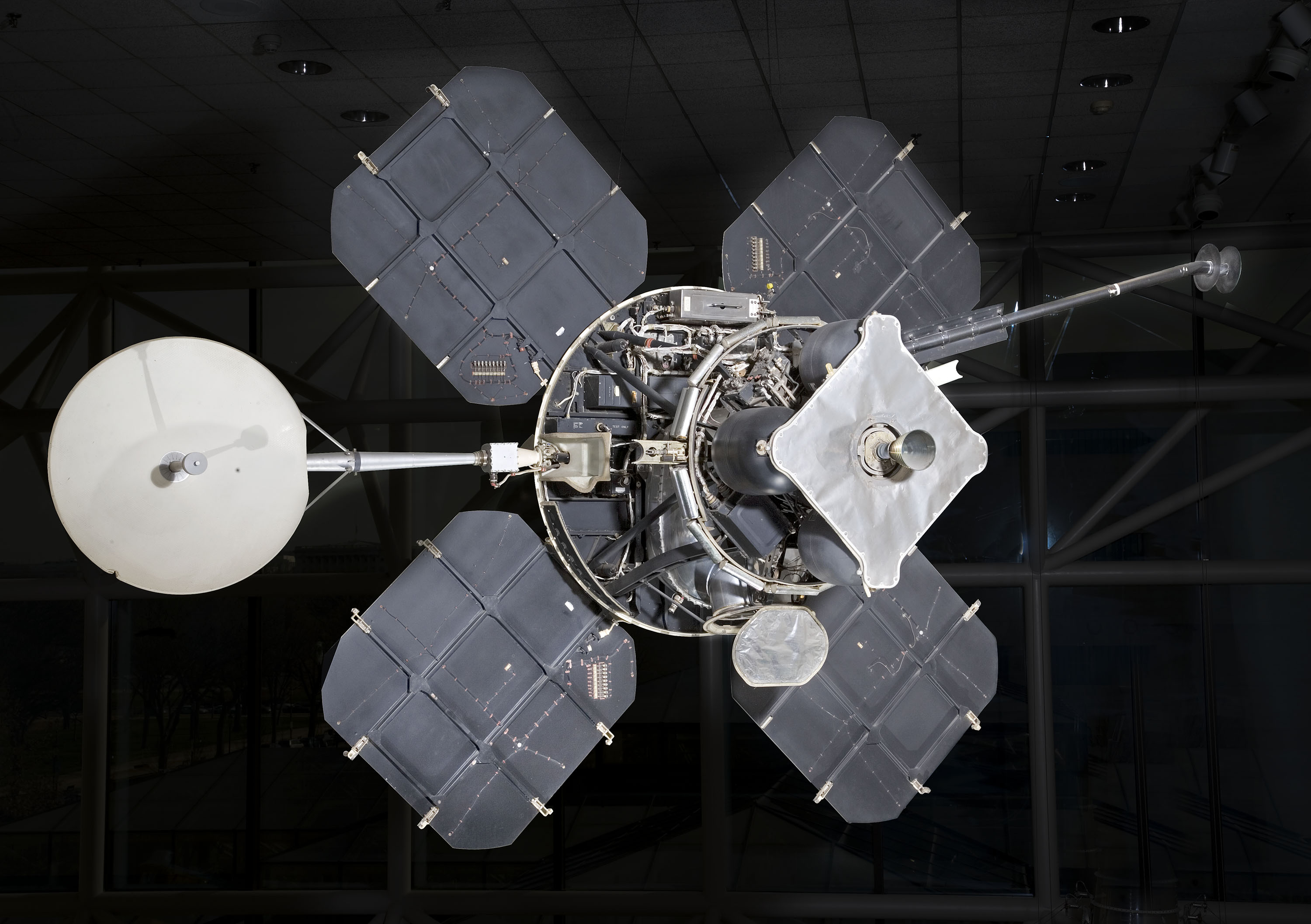
This artifact is one of several replicas and flight spare Explorer 1 spacecraft in the collection. It was identified as a fully instrumented flight spare of the Explorer-1 satellite attached to an empty fourth stage Sergeant rocket when it was transferred in 1961 to the collection by the NASA Jet Propulsion Laboratory, the builder of the object. It was initially displayed in the Arts and Industries Building. It was on loan to the Museum of Medical Progress in Madison, WI, (4/70-6/70) and briefly to WETA in Arlington, VA, (6/75-7/75). It was inspected in late 2005 and found to be empty of instrumentation save for the micrometeoroid sensor. But markings in the interior frame indicate it to be "Payload II" which was indeed the flight backup that was sent to James Van Allen's laboratory in Iowa for inspection and testing and then returned to JPL in 1958. That payload was donated to NASM by George Ludwig in 2006 (A20060086). The satellite is displayed in the Milestones of Flight Gallery at NASM.
Explorer-1 was the United States' first successful orbiting satellite. Following the failure of Vanguard in December 1957, the JPL- ABMA group was permitted to adapt the Jupiter-C reentry test vehicle to carry an instrumented satellite into earth orbit. The resulting Explorer-1 satellite was successfully launched and placed into Earth orbit on January 31, 1958. Explorer-1, also known unofficially as Satellite 1958 alpha, transmitted data on micrometeorites and cosmic radiation for 105 days. Data from this and two subsequent Explorer satellites led to the discovery by James Van Allen of a belt of intense radiation surrounding the earth.
Alternate Name
Explorer
Key Accomplishment(s)
First American Satellite
Impact or Innovation
"Launching the first artificial satellites began the space age and started the Soviet-American space race."
Brief Description
On January 31, 1958, Explorer 1 was successfully launched into orbit and became the first U.S. satellite. Explorer became the U.S. answer to the Soviet Union's Sputnik, which had been launched four months earlier.
Credit Line
Transferred from the National Aeronautics and Space Administration's Jet Propulsion Laboratory
Inventory Number
A19620034000
Restrictions & Rights
Usage conditions apply
Type
SPACECRAFT-Uncrewed
Materials
Steel, copper alloy, aluminum, rubber, paint, electrical wires
Dimensions
Other: 205.7 × 15.2cm, 12.9kg (81 × 6 in., 28 1/2lb.)
Country of Origin
United States of America
See more items in
National Air and Space Museum Collection
Location
National Air and Space Museum in Washington, DC
Exhibition
Boeing Milestones of Flight Hall
Data Source
National Air and Space Museum
Link to Original Record
Record ID
nasm_A19620034000