
Object Details
Manufacturer
NASA - Langley Research Center
Summary
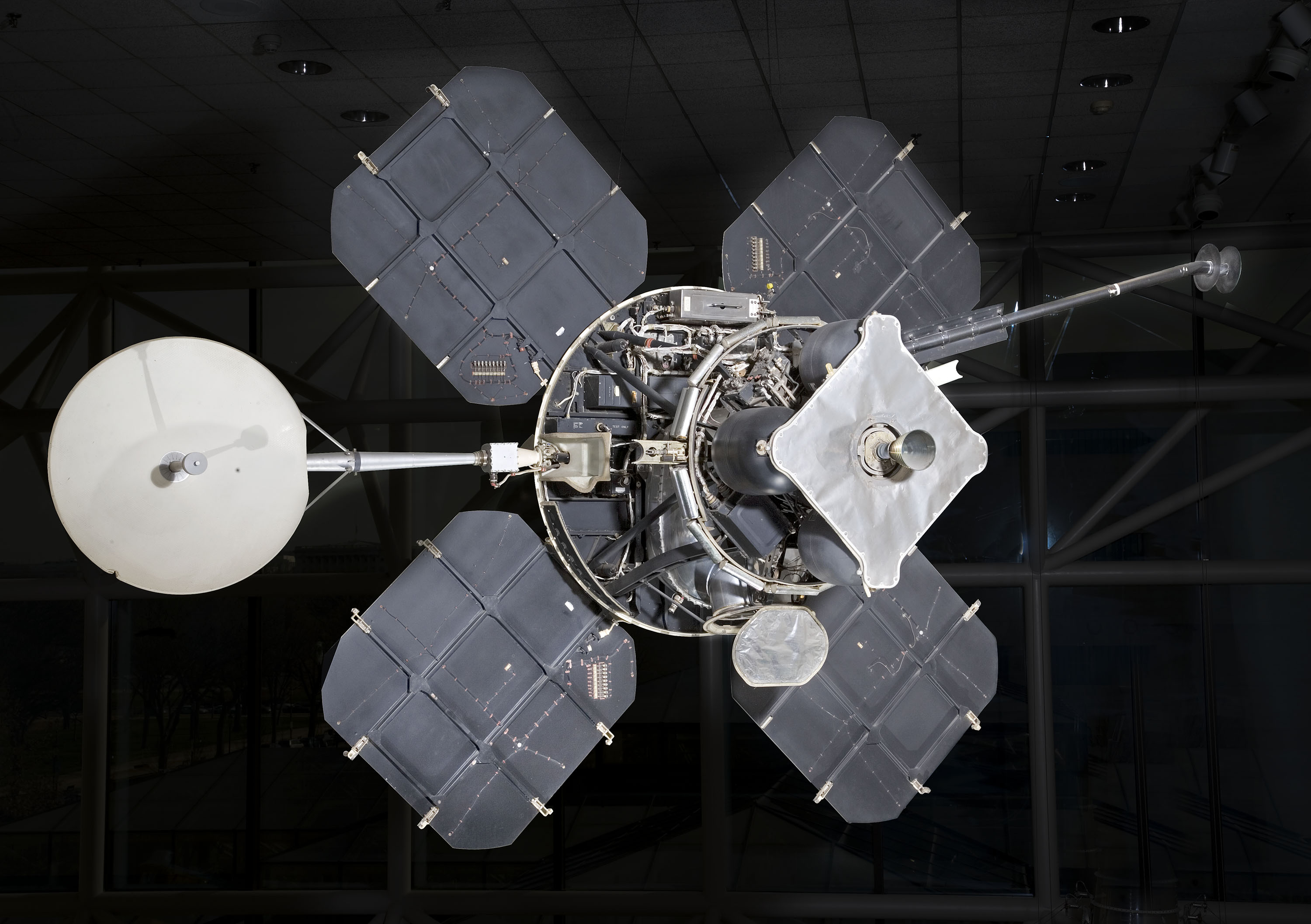
This is the flight backup to the Explorer 39 satellite. It is stowed in deflated form in a canister within its companion spacecraft, Explorer 40, mounted atop the Scout D launch vehicle on exhibit at NASM. The nose cone cover of the rocket has been replaced by a clear Plexiglas skin to display the payload. It was manufactured by NASA's Langley Research Center who transferred it to NASM in 1975.
Explorer 39/40 formed part of a coordinated dual-satellite experiment to measure particle flux and energy as well as very low frequency emissions in the ionosphere and atmospheric density. The spacecraft package in the Scout D display also includes the inflatable radar tracking beacon that comprised Explorer 39. Measurements were to be performed simultaneously with the two satellites during an active part of the solar cycle to give information on the effect of solar activity on atmospheric density. One of its tasks was to evaluate the continuing decay of the Starfish artificial radiation belt created earlier in the decade. These explorers were launched into a polar orbit from Vandenberg Air Force on August 8, 1968, and was operated periodically until June 1971.
NASA's Langley Research Center transferred this to the Museum in 1977.
Credit Line
Transferred from the National Aeronautics and Space Administration
Inventory Number
A19772726002
Restrictions & Rights
Usage conditions apply
Type
SPACECRAFT-Uncrewed
Materials
Metalized Mylar, silicon solar cells.
Dimensions
3-D (Cylinder, packed): 14 × 8cm (5 1/2 × 3 1/8 in.)
Country of Origin
United States of America
See more items in
National Air and Space Museum Collection
Data Source
National Air and Space Museum
Link to Original Record
Record ID
nasm_A19772726002