
Object Details
Manufacturer
NASA, Goddard Space Flight Center
Summary
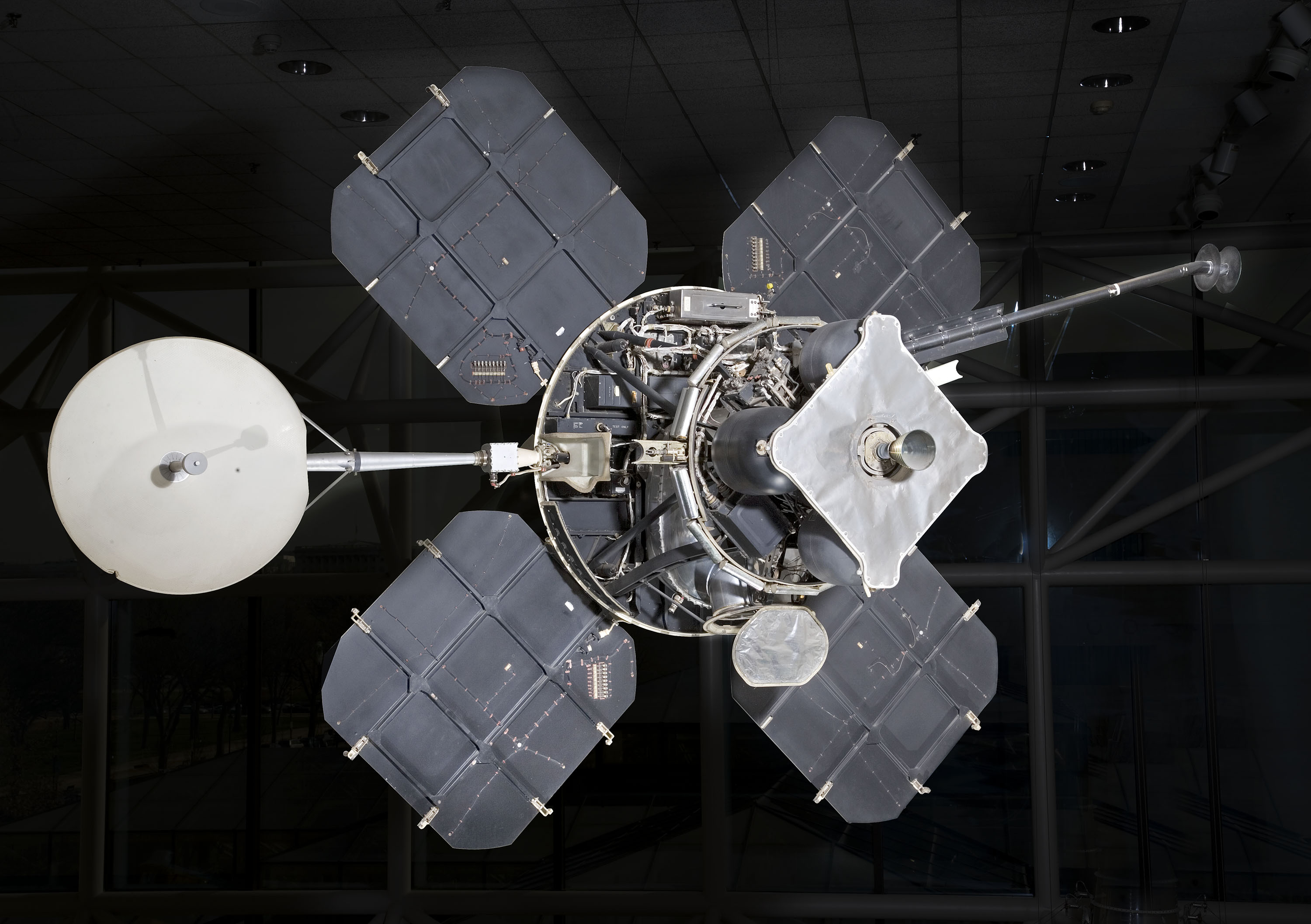
This is a refurbished full-scale replica of the Explorer 17 aeronomy satellite. Explorer 17 was one of the first launched by NASA to study the Earth's upper atmosphere. The pressurized stainless steel sphere carried instruments to measure density, pressure, and temperature. It also contained a neutral mass spectrometer to study the composition of the gases in the upper atmosphere. The satellite was placed in a 158- to 570-mile orbit on April 3, 1963 by a Thor Delta launch vehicle. Data from the mass spectrometer showed the presence of molecular oxygen, atomic and molecular nitrogen and argon in the upper atmosphere; it also led to the discovery of a belt of neutral helium about the Earth. Constructed of original parts, it was refurbished by technicians at the Goddard Space Flight Center prior to its transfer to NASM from NASA in March 1975.
Alternate Name
Explorer 17 Satellite (Replica)
Credit Line
Transferred from the National Aeronautics and Space Administration
Inventory Number
A19751409000
Restrictions & Rights
Usage conditions apply
Type
SPACECRAFT-Uncrewed
Materials
Stainless steel
Dimensions
Overall: 2 ft. 11 in. wide, 80 lb. (88.9cm, 36.3kg)
Country of Origin
United States of America
See more items in
National Air and Space Museum Collection
Location
Steven F. Udvar-Hazy Center in Chantilly, VA
Exhibit Station
Space Science
Data Source
National Air and Space Museum
Link to Original Record
Record ID
nasm_A19751409000