
Object Details
Manufacturer
Jet Propulsion Laboratory, California Institute of Technology
Summary
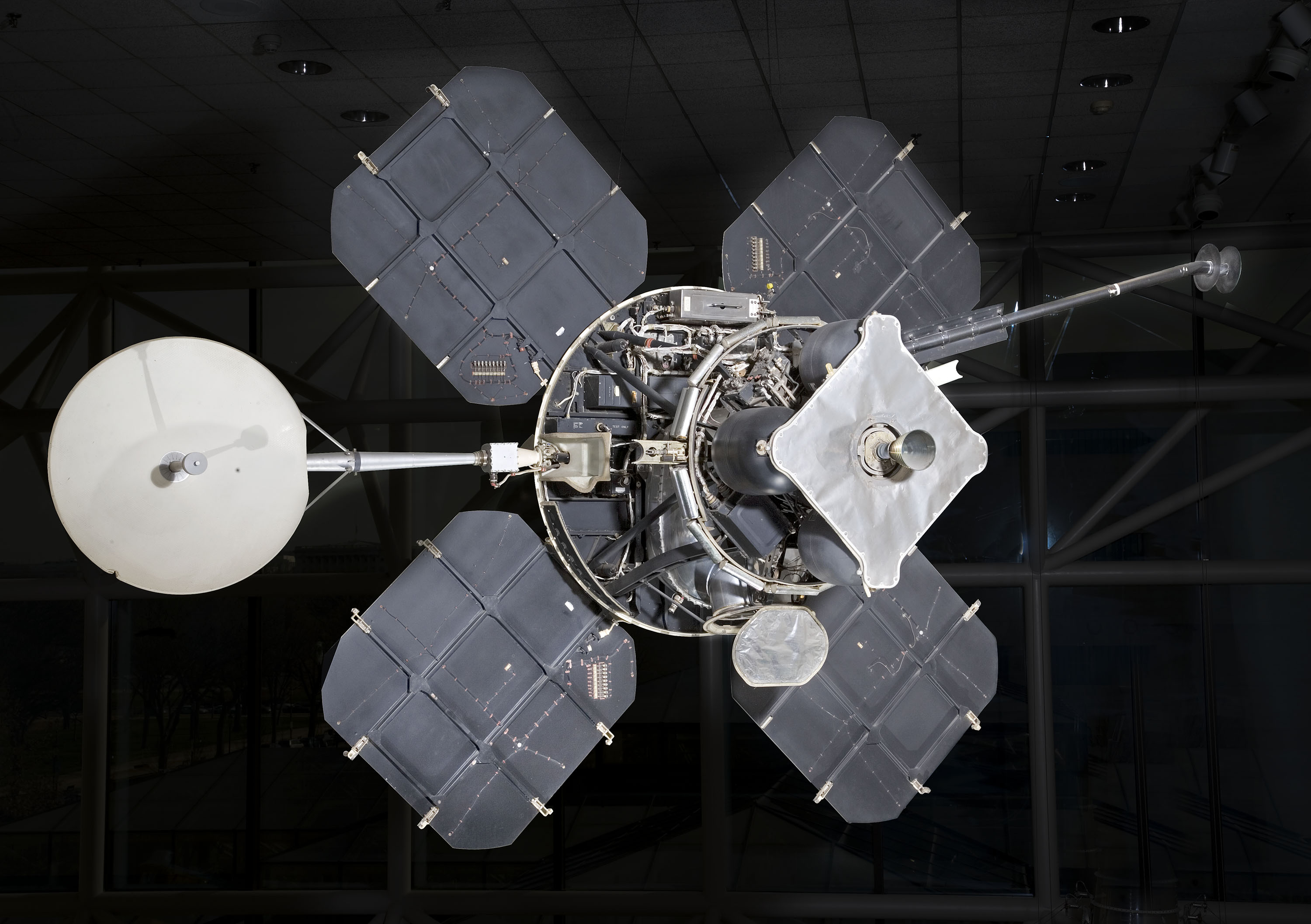
This is one of several replicas of the Explorer 1 in the collection consisting of machined metal shells of the payload section. Explorer-1 was the first American satellite to successfully orbit the Earth. The launch of Sputnik-1 on October 4, 1957 and the launch failure of the Vanguard-1 satellite in December of that year seemed to symbolize America's failure to lead in the Space Race. Since the mid-1950's Caltech's Jet Propulsion Laboratory (JPL) had underway a development program for missile reentry vehicles in conjunction with the Army Ballistic Missile Agency (ABMA). Soon after the Vanguard failure the JPL- ABMA team were authorized to adapt the Jupiter-C reentry test vehicle to an instrumented earth satellite. The resulting Explorer-1 satellite was successfully launched and placed into Earth orbit on January 31, 1958. The satellite transmitted data on micrometeorites and cosmic radiation for 105 days. Data from this and two subsequent Explorer satellites led to the discovery by James Van Allen of a belt of intense radiation surrounding the Earth.
Transferred to NASM by JPL via NASA in February 1975.
Credit Line
Transferred from the National Aeronautics and Space Administration
Inventory Number
A19751442000
Restrictions & Rights
Usage conditions apply
Type
SPACECRAFT-Uncrewed-Parts & Structural Components
Materials
Aluminum
Steel
Paint
Copper Alloy
White metal plating
Paper
Adhesive
Ink
Dimensions
3-D: 94 × 15.6cm (37 × 6 1/8 in.)
Storage: 104.1 × 20.3 × 20.3cm (41 × 8 × 8 in.)
Country of Origin
United States of America
See more items in
National Air and Space Museum Collection
Data Source
National Air and Space Museum
Link to Original Record
Record ID
nasm_A19751442000