
Object Details
Manufacturer
Lavochkin Scientific Production Association
Summary
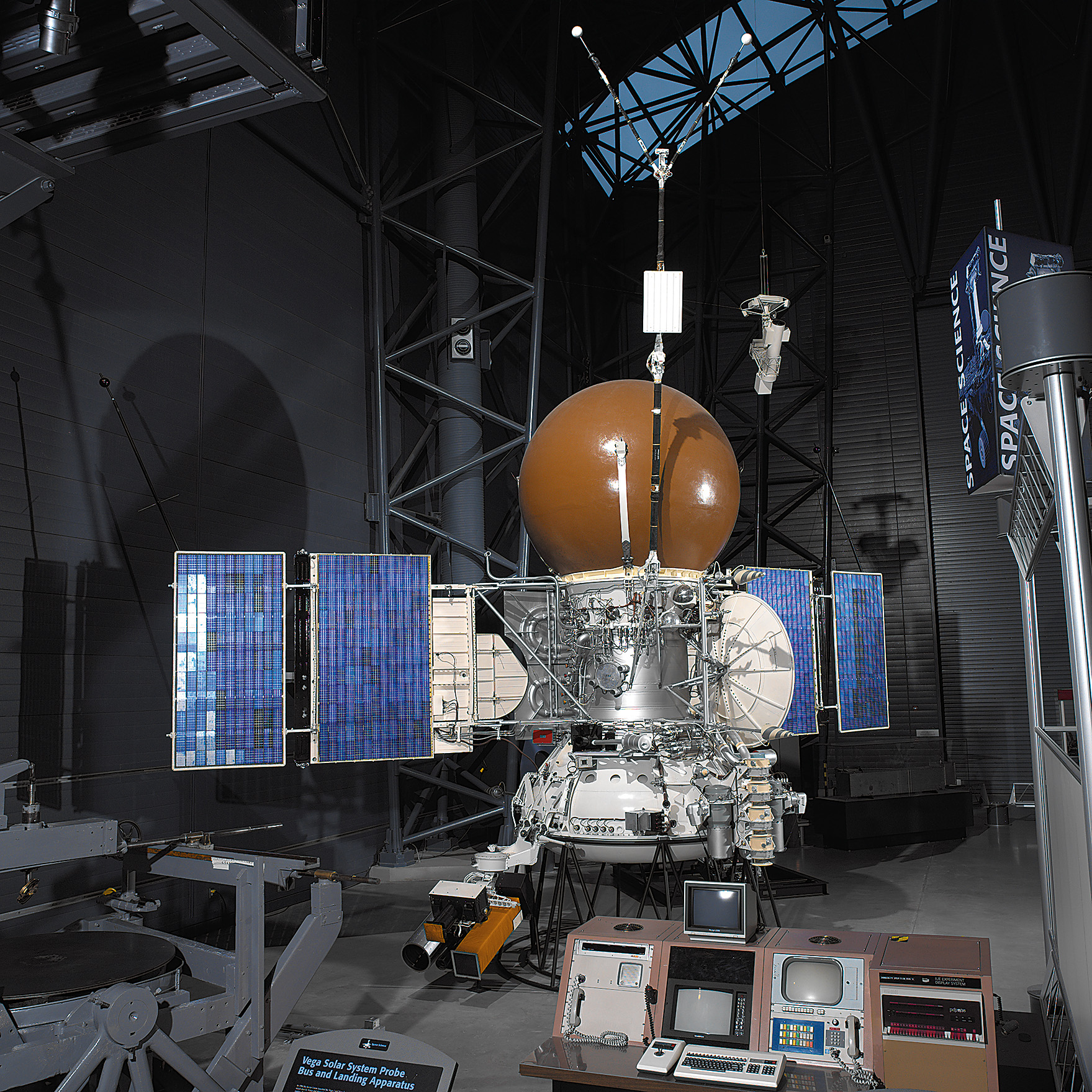
This is a desktop model of the Soviet Granat astrophysics satellite. The formal name of the spacecraft was the International Astrophysical Observatory, but it is known by the Russian word, Granat, which means pomegranate. Soviet, French, Danish and Bulgarian scientists participated in the design and construction of the observatory and its seven major instruments. The Soviet Union launched the satellite on 1 December 1989 on board a Proton launch vehicle from the Baikonur Cosmodrome in the Soviet Republic of Kazakhstan. Granat's orbit was highly elliptical and it took for days for the satellite to orbit the Earth. The instruments conducted their observations when the space vehicle was furthest from the Earth. Granat's instruments were designed to observe energies between x-rays and gamma rays.
The spacecraft itself was a three-axis stabilized craft and built on the Venera-class base that the production company, NPO Lavochkin, had designed. The most famous spacecraft on this base was the Vega, which was the probe that the Soviets sent to the planet Venus and Comet Halley in 1986. Granat continued to operate for five years, outlasting the USSR. At that time, the craft had depleted the gas necessary to turn the craft and point it properly. It stopped transmitting all signals in 1998.
The director of NPO Lavochkin donated this model to the museum when the museum was negotiating for a loan of a full-scale engineering model of the Vega spacecraft during the early 1990s.
Long Description
This is a desktop model of the Soviet Granat astrophysics satellite. The formal name of the spacecraft was the International Astrophysical Observatory, but it is known by the Russian word, Granat, which means pomegranate. Soviet, French, Danish and Bulgarian scientists participated in the design and construction of the observatory and its seven major instruments. The Soviet Union launched the satellite on 1 December 1989 on board a Proton launch vehicle from the Baikonur Cosmodrome in the Soviet Republic of Kazakhstan. Granat's orbit was highly elliptical and it took for days for the satellite to orbit the Earth. The instruments conducted their observations when the space vehicle was furthest from the Earth. Granat's instruments were designed to observe energies between x-rays and gamma rays.
The spacecraft itself was a three-axis stabilized craft and built on the Venera-class base that the production company, NPO Lavochkin, had designed. The most famous spacecraft on this base was the Vega, which was the probe that the Soviets sent to the planet Venus and Comet Halley in 1986. Granat continued to operate for five years, outlasting the USSR. At that time, the craft had depleted the gas necessary to turn the craft and point it properly. It stopped transmitting all signals in 1998.
The director of NPO Lavochkin donated this model to the museum when the museum was negotiating for a loan of a full-scale engineering model of the Vega spacecraft during the early 1990s.
Credit Line
Gift of Lavochkin Scientific Production Association
Inventory Number
A19940075000
Restrictions & Rights
Usage conditions apply
Type
MODELS-Uncrewed Spacecraft & Parts
Materials
Base - Painted Metal
Overall - Metal
Dimensions
Overall: 35.24 x 5.88 x 4.31cm (1ft 1 7/8in. x 2 5/16in. x 1 11/16in.)
Country of Origin
Union of Soviet Socialist Republics
See more items in
National Air and Space Museum Collection
Data Source
National Air and Space Museum
Link to Original Record
Record ID
nasm_A19940075000