
Object Details
Manufacturer
Republic Aviation Corporation
Summary
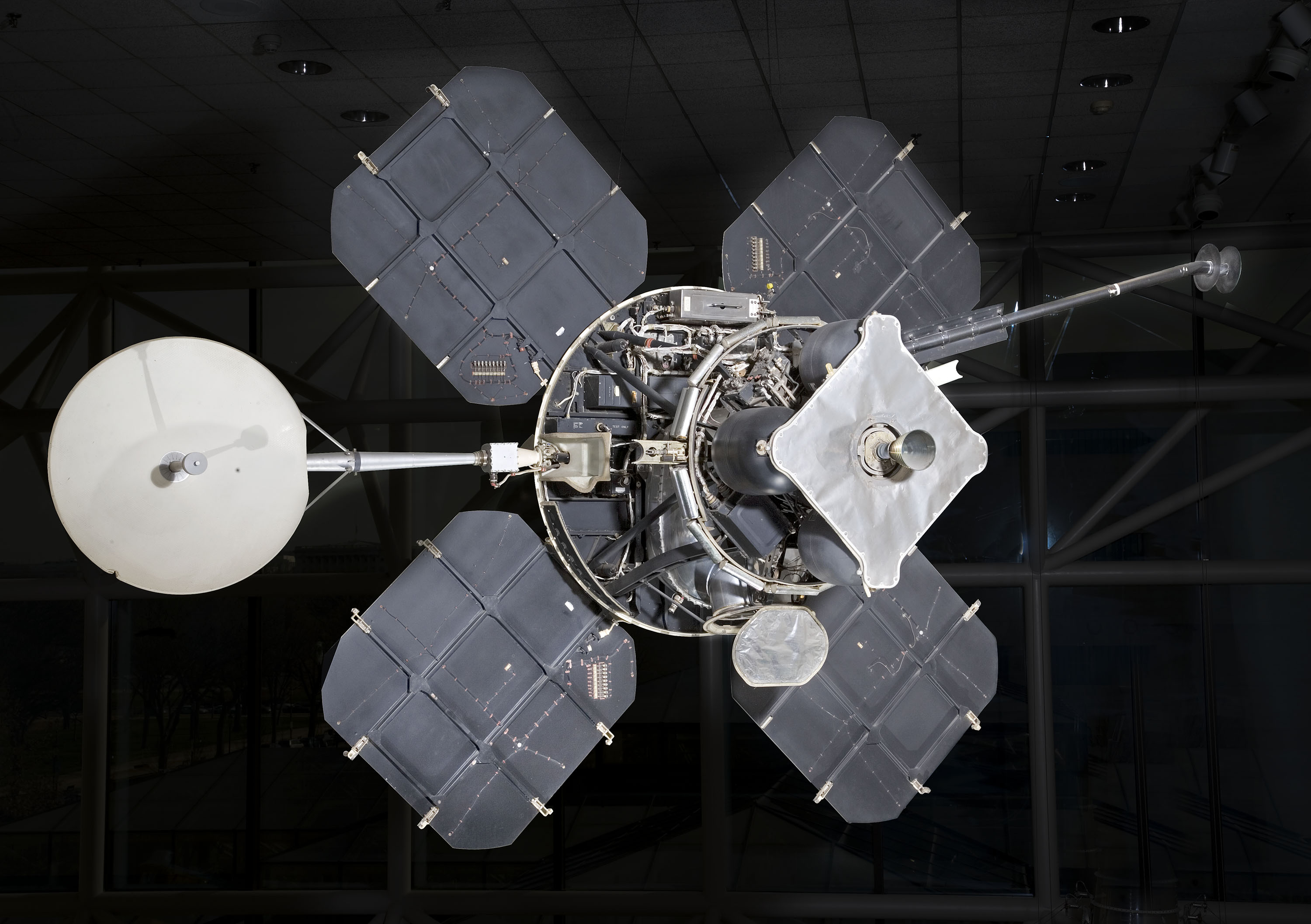
This is the full-scale engineering flight model of the Advanced Orbiting Solar Observatory (AOSO) representing its most complete configuration. This satellite was designed as a scaled-up counterpart to the Orbiting Solar Observatory series in the early 1960s. It was conceived as a free-flying, robotic, polar-orbiting satellite system capable of continuously monitoring the sun and near solar environment using an array of detectors and electronic imaging devices covering a broad frequency band from the x-ray to the visual range. Many of the scientific instruments planned for AOSO eventually were developed for the Skylab Apollo Telescope Mount, which flew in 1973.
The AOSO program was canceled in 1965, and this object was transferred to NASM by NASA in 1969. The historical question remains: why was AOSO cancelled? One conjecture: in the mid-1960s electronic imaging and recording was still not reliable enough to handle very high resolution images of spectra and spatial objects. Film recording required either on-board scanning and telemetry, or physical return. The latter would be possible if the satellite was periodically attended by astronauts. This requjirement lent itself to plans for the post-Apollo Skylab program. Accordingly, the array of telescopes, as reconfigured for Skylab, came to be known as the Apollo Telescope Mount.
Alternate Name
Advanced Orbiting Solar Observatory
Credit Line
Transferred from the National Aeronautics and Space Administration
Inventory Number
A19700232000
Restrictions & Rights
Usage conditions apply
Type
SPACECRAFT-Uncrewed
Materials
Aluminum sheet and bar stock
Dimensions
Overall: 4ft 12in. x 10ft 6in., 1075lb. (152.4 x 320cm, 487.6kg)
Country of Origin
United States of America
See more items in
National Air and Space Museum Collection
Location
Steven F. Udvar-Hazy Center in Chantilly, VA
Exhibit Station
Space Science
Data Source
National Air and Space Museum
Link to Original Record
Record ID
nasm_A19700232000