
Object Details
Manufacturer
Rolls-Royce Ltd. (Derby, U.K.)
Physical Description
Type: Turbojet
Thrust: 16,622 N (3,737 lb) at 13,760 rpm
Compressor: 8-stage axial
Combustor: Annular
Turbine: 2-stage axial
Weight: 358 kg (790 lb)
Summary
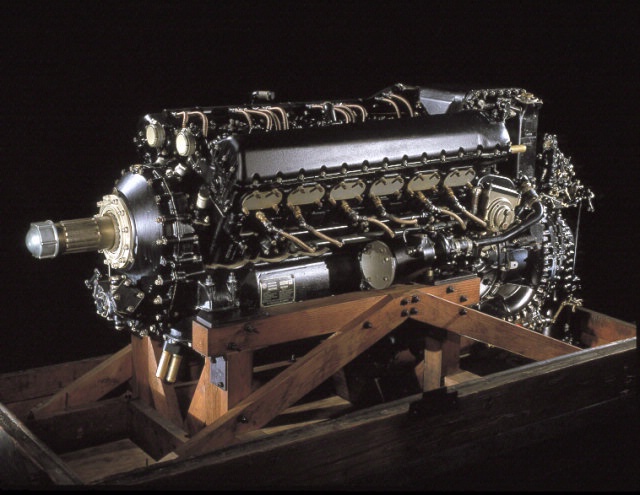
Designed in 1948 as an expendable 7,006 N (1,575 lb) thrust turbojet for the Australian Jindivik target drone and still manufactured in the 1990s, this engine had one of the longest production runs of any turbojet. In 1952 the Viper 5 eliminated expendable features, giving the Royal Air Force the world's first all-through jet training system with the Jet Provosts. Uprated Viper 11's powered the majority of second generation trainer aircraft, such as Jet Provost Mark 4, Italian Macchi MB.326, Jogoslav SOKO Galeb, and Indian HAL HJT-16 Kiran.
The Viper 500, a Viper 11 derivation, was created for business, military trainer and light combat aircraft. The Mk. 601 series was the last having civilian application. In September 1973, this engine was installed on a Beechcraft-Hawker BH 125 Series 600A business aircraft, Ser. No. 256023, N514V. It was removed from service in April 1986 and donated to the National Air and Space Museum in October.
Credit Line
Gift of Rolls-Royce, Inc.
Date
August 23, 1973
Inventory Number
A19870001000
Restrictions & Rights
Usage conditions apply
Type
PROPULSION-Turbines (Jet)
Materials
HAZ MAT: Cadmium
Aluminum Alloy
Ferrous Alloy
Paints
Rubbers
Plastics
Non-Magnetic White Metal
Dimensions
3-D: 294 × 71.1 × 75.6cm (9 ft. 7 3/4 in. × 2 ft. 4 in. × 2 ft. 5 3/4 in.)
Overall: 790lb. (358.3kg)
Country of Origin
United Kingdom
See more items in
National Air and Space Museum Collection
Data Source
National Air and Space Museum
Link to Original Record
Record ID
nasm_A19870001000