
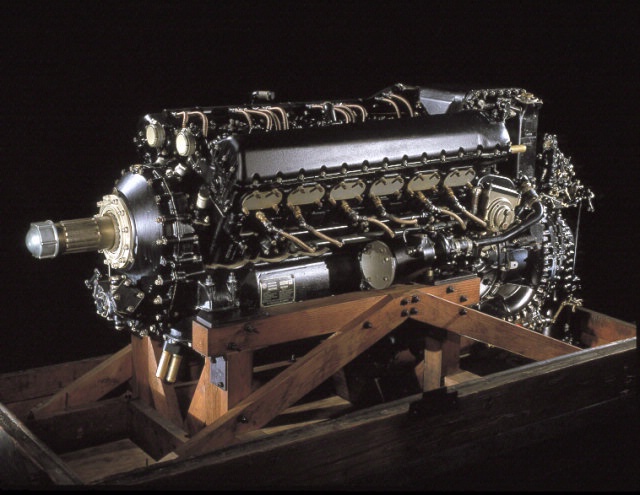
Object Details
Manufacturer
Rolls-Royce Ltd (Glasgow, Scotland)
Physical Description
Type: Reciprocating engine, 12 cylinders, V-type, pressure liquid cooled, supercharged
Power rating: 1,227 kW (1,645 hp) at 3,000 rpm
Displacement: 27 L (1,649 cu in.)
Bore and Stroke: 137 mm (5.4 in.) x 152 mm (6 in.)
Weight: 778 kg (1,715 lb)
Summary
Formed in 1906 to first produce automobiles, Rolls-Royce was asked to begin designing and building aircraft engines at the outbreak of World War I in 1914. Design of the Merlin began in 1933 following the similar Kestrel design, and helped pioneer high-output, liquid-cooled engines. Early Rolls-Royce Merlin Mk II and Mk III engines, producing about 746 kW (1,000 horsepower), powered Hawker Hurricanes and Supermarine Spitfires in the Battle of Britain. Engine improvements and progress in supercharger performance increased the Merlin's rated power to over 1,715 kW (2,300 horsepower) by the end of the war.
Built at the Rolls-Royce Hillington factory in Glasgow, Scotland, and first tested in September 1944, this engine is a prototype in the Merlin 100 series. A new class of engine, built to meet higher performance standards for power and altitude, Merlin 100s powered the de Havilland Mosquito, Avro Tudor, and de Havilland Hornet and Sea Hornet.
Credit Line
Transferred from the U.S. Army Air Forces
Date
Circa World War II
Inventory Number
A19670069000
Restrictions & Rights
Usage conditions apply
Type
PROPULSION-Reciprocating & Rotary
Materials
Non-Magnetic White Metal
Ferrous Alloy
Copper Alloy
Paint
Unknown Coating
Glass
Plastic
Dimensions
Length 225 cm (88.7 in.), Width 78 cm (30.7 in.), Height 101 cm (39.9 in.)
Country of Origin
United Kingdom
See more items in
National Air and Space Museum Collection
Data Source
National Air and Space Museum
Link to Original Record
Record ID
nasm_A19670069000