
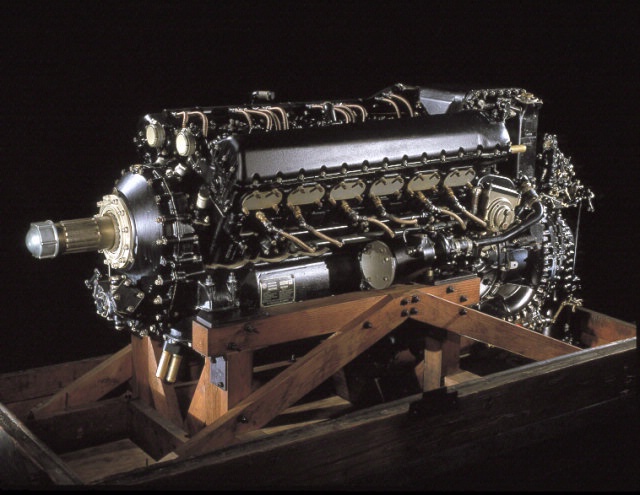
Object Details
Manufacturer
Rolls-Royce Ltd. (Derby, U.K.)
Physical Description
Type: Turbofan, 2-shaft
Thrust: 77,800 N (17,500 lb) at 9,990 rpm
Compressor: 7-stage low-pressure axial, 9-stage high pressure axial
Combustor: Annular
Turbine: Single-stage high pressure axial, 2-stage low pressure axial
Weight: 2,060 kg (4,542 lb)
Summary
The Conway was the first production bypass (turbofan) engine. Turbofan technology is characterized by lower specific fuel consumption, higher take-off thrust, and quieter operation than turbojets. These characteristics make the turbofan especially suitable for long-range civil airliners. The Conway engine powered the Douglas DC8-40, Boeing 707-420, Vickers VC-10 and Super VC-10 airliners. It was also used on the Handley Page Victor B. Mk. 2 bomber and K.2 aerial tanker.
The British government funded development of the engine in 1952. It first ran in 1953, and completed its government type-test in 1955, at which time it had the lowest specific fuel consumption of any type-tested jet engine. After extensive use in early jet airliners, it was eventually replaced by engines having much higher bypass ratios.
This Conway RCo.12 Mark 509 was built by Rolls-Royce in Derby, England and powered the Douglas DC8-40 and Boeing 707-420.
Credit Line
Gift of International Air Leases, Inc.
Date
March 1959
Inventory Number
A19870225000
Restrictions & Rights
Usage conditions apply
Type
PROPULSION-Turbines (Jet)
Materials
Magnesium, Steel, Aluminum, Rubber, Paint, Stainless Steel, Inconel, Textile, Plastic
Dimensions
Length 345 cm (135.9 in.), Diameter 107 cm (42.2 in.)
Country of Origin
United Kingdom
See more items in
National Air and Space Museum Collection
Data Source
National Air and Space Museum
Link to Original Record
Record ID
nasm_A19870225000