
Object Details
Manufacturer
Rolls-Royce Ltd. (Derby, U.K.)
Physical Description
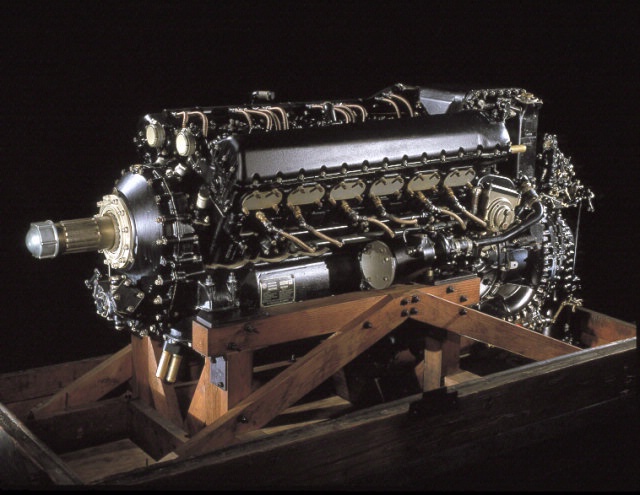
Type: Reciprocating, 12 cylinders, V-type, overhead cam, liquid cooled, supercharged
Power rating: 615 kW (825 hp) at 2,000 rpm
Displacement: 36.7 L (2,240 cu in)
Bore and Stroke: 152 mm (6 in.) x 165 mm (6.5 in.)
Weight (dry): 657 kg (1,448 lb)
Summary
Following its success as an automobile manufacturer, Rolls-Royce began design and development of aircraft engines at the request of the British Admiralty at the beginning of World War I. In June 1927, Rolls-Royce began designing a scaled-up version of its supercharged Kestrel to power large flying boats. Later known as the Buzzard, the prototype was completed in 1928 and installed experimentally in large aircraft, both flying boats and land planes. Rolls-Royce sold less than 50 production engines, 32 of them to the Japanese. Even though Rolls-Royce abandoned the Buzzard within a few years, the development work on it proved important; serving as the basis for the R engine, which won the Schneider Trophy in 1929 and 1931.
Designated V-2240-56, this engine was performance tested by the U.S. Navy Aeronautical Engine Laboratory in the early 1930s. The H.XIV model powered the Blackburn B.3, Handley Page H.P.46, Hawker Horsley, Short S.14 Sarafand R.6/28, and Vickers 207 M.1/30.
Credit Line
Transferred from the U.S. Navy
Date
Circa 1928
Inventory Number
A19710924000
Restrictions & Rights
CC0
Type
PROPULSION-Reciprocating & Rotary
Materials
Steel, Aluminum, Paint., Rubber, Stainless Steel, Wood, Preservative coating, Copper
Dimensions
Height 111.8 cm (44 in.), Width 77.7 cm (30.56 in.), Depth 223 cm (87.81 cm)
Country of Origin
United Kingdom
See more items in
National Air and Space Museum Collection
Data Source
National Air and Space Museum
Link to Original Record
Record ID
nasm_A19710924000