Skip to main content Skip to main navigation
heart-solid My Visit Donate
Home Smithsonian Institution IK development site for ODI
Press Enter to activate a submenu, down arrow to access the items and Escape to close the submenu.
    • Overview
    • Museums and Zoo
    • Entry and Guidelines
    • Museum Maps
    • Dine and Shop
    • Accessibility
    • Visiting with Kids
    • Group Visits
    • Overview
    • Exhibitions
    • Online Events
    • All Events
    • IMAX & Planetarium
    • Overview
    • Topics
    • Collections
    • Research Resources
    • Stories
    • Podcasts
    • Overview
    • For Caregivers
    • For Educators
    • For Students
    • For Academics
    • For Lifelong Learners
    • Overview
    • Become a Member
    • Renew Membership
    • Make a Gift
    • Volunteer
    • Overview
    • Our Organization
    • Our Leadership
    • Reports and Plans
    • Newsdesk
heart-solid My Visit Donate

Probe, Mars 96 with Mars Oxidation Experiment

Air and Space Museum

There are restrictions for re-using this image. For more information, visit the Smithsonian's Terms of Use page .
International media Interoperability Framework
IIIF provides researchers rich metadata and media viewing options for comparison of works across cultural heritage collections. Visit the IIIF page to learn more.
View manifest View in Mirador Viewer

    Object Details

    Manufacturer

    Lavochkin Scientific Production Association

    Subcontractor

    NASA - Jet Propulsion Laboratory

    Summary

    This is an engineering model for a planned Russian scientific probe that would land on the surface of Mars. The Mars 96 mission was going to be a multi-national and multi-mission exploration of Mars, which was to follow the successful Venus probes Vega 1 and 2 of the previous decade. Unfortunately, the first missions in this series, Phobos 1 and 2, failed to accomplish their goals, and the Mars 96 mission failed to reach Mars. Nevertheless, this small surface station is an excellent example of the hardware design that Lavochkin Company of Russia has refined during its thirty-five years of building planetary probes.
    The actual station carried experiments from France, Finland, Germany and the US inside the Russian-made bus. Of the four experimental slots in the block, the NASA Jet Propulsion Laboratory's back up of the Mars Oxidation Experiment (MOx) occupies one. That experiment was the United States' contribution to the mission.
    The Jet Propulsion Laboratory transferred this object to the museum in 2001.

    Credit Line

    Transferred from the National Aeronautics and Space Administration

    Inventory Number

    A19990217000

    Restrictions & Rights

    Usage conditions apply

    Type

    SPACECRAFT-Uncrewed

    Materials

    Overall: Metal (aluminum, copper, brass)

    Dimensions

    Overall: 9 in. tall x 4 ft. 2 in. diameter (22.86 x 127cm)

    Country of Origin

    Russian Federation

    See more items in

    National Air and Space Museum Collection

    Location

    Steven F. Udvar-Hazy Center in Chantilly, VA

    Exhibit Station

    Space Science

    Data Source

    National Air and Space Museum

    Metadata Usage

    Not determined

    Link to Original Record

    http://n2t.net/ark:/65665/nv935444c89-beb7-494d-be2c-25c0af8d54f4

    Record ID

    nasm_A19990217000

    Discover More

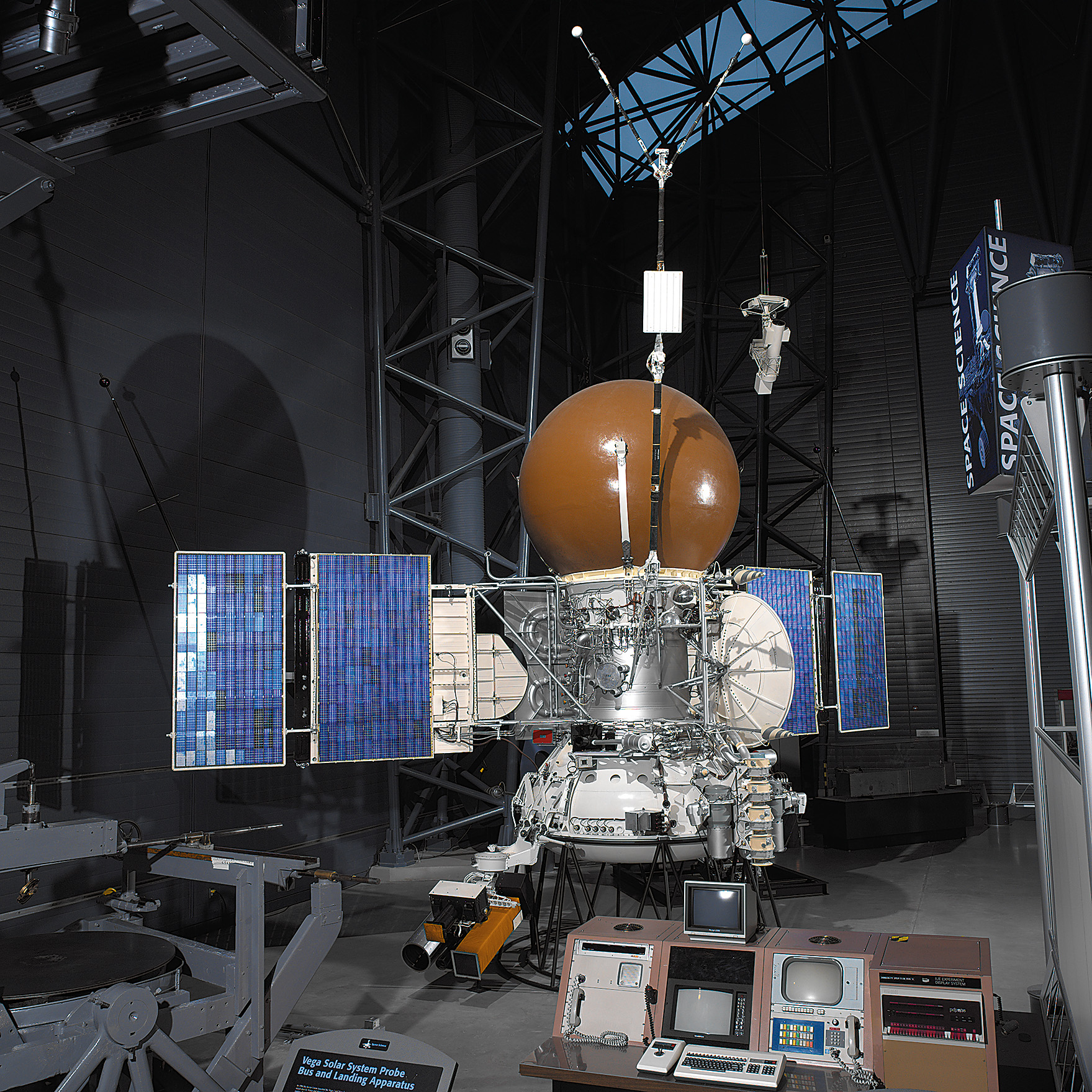
    Image of Vega solar system probe bus and landing apparatus

    International Space

    Image of Vega solar system probe bus and landing apparatus

    International Space

    arrow-up Back to top
    Home
    • Facebook facebook
    • Instagram instagram
    • LinkedIn linkedin
    • YouTube youtube

    • Contact Us
    • Get Involved
    • Shop Online
    • Job Opportunities
    • Equal Opportunity
    • Inspector General
    • Records Requests
    • Accessibility
    • Host Your Event
    • Press Room
    • Privacy
    • Terms of Use