
Object Details
Manufacturer
Pratt & Whitney
Physical Description
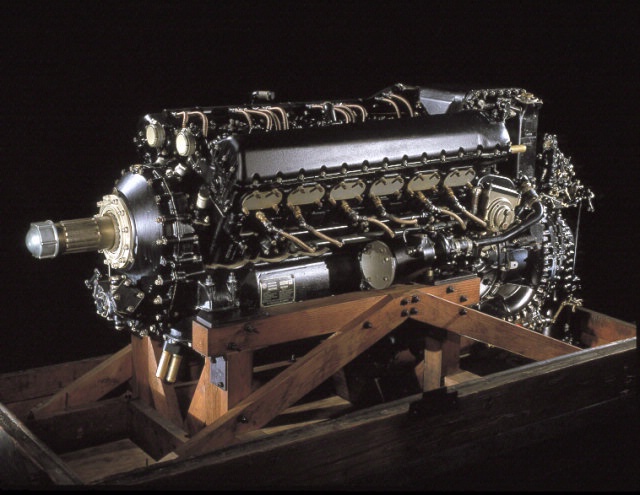
Type: Reciprocating, 28 cylinders, 4-rows, radial, air cooled, supercharged
Power rating: 2,237 kW (3,000 hp) at 2,700 rpm
Displacement: 71.5 L (4,360 cu in.)
Bore and Stroke: 146 mm (5.8 in.) x 152 mm (6.0 in.)
Weight: 1,636 kg (3,600 lb)
Summary
The Wasp Major was Pratt & Whitney’s last big piston engine. Although four rows in the radial configuration seems a cooling problem, the Wasp Major was effectively cooled by staggering each of its rows of seven cylinders. It was reliable in flight, but required extensive and time consuming checks at startup and shutdown.
Beginning in 1941, the gigantic Convair B-36 strategic bomber was likely planned around this engine, which used six R-4360s along with four turbojets. The Wasp Major saw service at the end of World War II in late Boeing B-29s that were actually early B-50s, and was used on the Boeing B-50 "Lucky Lady" when it made the first non-stop around the world flight from Fort Worth, Texas, in 1949.
Other principal applications were in the Douglas C-124 Globemaster and the civilian Boeing Stratocruiser, which was derived from the B-50.
Credit Line
Transferred from the U.S. Navy, Naval Supply Center, Cheatham Annex, Williamsburg, Virginia
Date
Circa World War II
Inventory Number
A19731549000
Restrictions & Rights
Usage conditions apply
Type
PROPULSION-Reciprocating & Rotary
Materials
Steel, Aluminum, Paint, Ceramic, Rubber, Textile, Phenolic, Preservative Coating, Copper
Dimensions
Storage: 273 × 162.6 × 181.6cm, 1921kg (8 ft. 11 1/2 in. × 5 ft. 4 in. × 5 ft. 11 1/2 in., 4235lb.)
Country of Origin
United States of America
See more items in
National Air and Space Museum Collection
Data Source
National Air and Space Museum
Link to Original Record
Record ID
nasm_A19731549000