
Object Details
Manufacturer
Pratt & Whitney
Physical Description
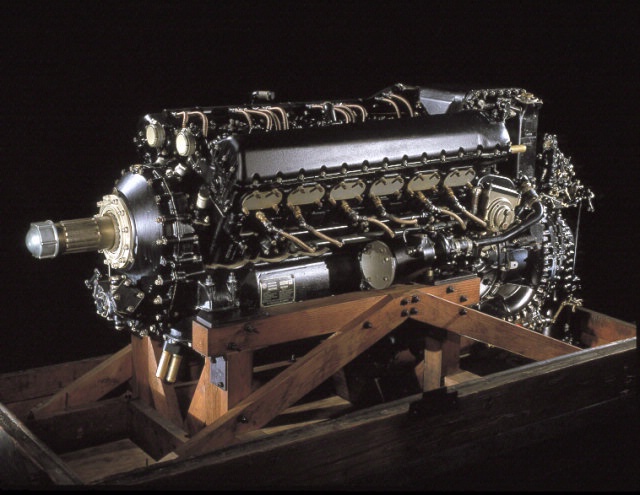
Type: Reciprocating, 28 cylinders, radial, air cooled, four rows
Power rating: 2,424 kW (3,250 hp) at 2,700 rpm
Displacement: 71.5 L (4,360 cu. in.)
Bore and Stroke: 146 mm (5.8 in.) x 152 mm (6 in.)
Weight: 1,626 kg (3,584 lb)
Summary
The Wasp Major was Pratt & Whitney Aircraft's last and largest piston engine. Its cylinders were in four rows, arranged in a spiral for better cooling. Initially producing 2,237 kW (3,000 shp), later models developed 3,207 kW (4,300 shp). It was reliable in flight, but required extensive and time consuming checks at startup and shutdown.
The gigantic Convair B-36 strategic bomber was likely planned around this engine, which used six R-4360s along with four turbojets. The Wasp Major saw service at the end of World War II in late Boeing B-29s that were actually early B-50s, and was used on the Boeing B-50 "Lucky Lady" when it made the first non-stop around the world flight in 1949.
This artifact powered a Boeing Model 377 Stratocruiser, one of the last generation of large propeller-driven commercial airliners. It is a Q.E.C. (Quick Engine Change) unit, complete with engine cowling, designed for rapid engine changes to minimize aircraft out-of-service time.
Credit Line
Gift of June Freemanzon
Date
Circa 1949
Inventory Number
A19910072000
Restrictions & Rights
Usage conditions apply
Type
PROPULSION-Reciprocating & Rotary
Materials
Aluminum, Magnesium, Steel, Rubber, Plastic, Copper, Stainless Steel, Paint, Textile
Dimensions
Diameter 139.7 cm (55 in.), Length 245.1 cm (96.5 in.)
Country of Origin
United States of America
See more items in
National Air and Space Museum Collection
Data Source
National Air and Space Museum
Link to Original Record
Record ID
nasm_A19910072000