
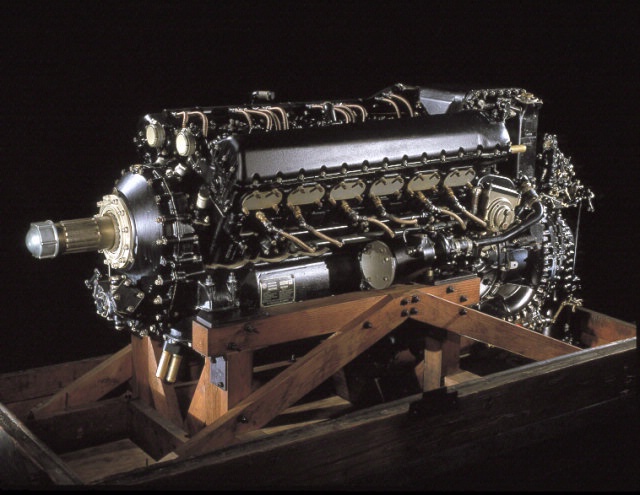
Object Details
Manufacturer
Pratt & Whitney
Physical Description
Type: Turboprop
Power Rating: 4,101 kw (5,500 ehp) at 11,000 rpm
Compressor: 13-stage axial
Combustor: Cannular
Turbine: 3-stage axial
Weight: 1,211 kg (2,670 lb)
Summary
The 3,057 kw (4,100 ehp) XT34-P-2 was developed originally as a dependable simple-cycle turboprop engine for use in high performance, long-range aircraft, and possibly later as a free turbine engine. A design contract for the T34-P-2 was issued in 1945, and amended in 1946 to continue development and component testing. The first engine was tested in January 1948.
The T34 turboprop engine first flew in September 1950, installed in the nose of a B-17 flying test bed, and the four-engine Boeing KC-97J, which survived as the B-377 Super Guppy, was its first application. The Air Force then selected the P-3 model for the Douglas C-133A Cargomaster, also having four engines. Service records indicate this artifact was installed on that model aircraft between 1969 and 1971.
Later development resulted in the 6,816 kw (9,140 ehp) XT48-P-2, considered for the dual engine VP-HL, a heavy, land based naval patrol aircraft that eventually led to the well known four-engine P-3 Orion.
Credit Line
Transferred from the U.S. Air Force, Dover AFB, Delaware
Date
1955
Inventory Number
A19721343000
Restrictions & Rights
Usage conditions apply
Type
PROPULSION-Turbines (Jet)
Dimensions
Length 398 cm (156.8 in.), Diameter 86 cm (33.75 in.) (Dimensions for T34-P-3)
Country of Origin
United States of America
See more items in
National Air and Space Museum Collection
Data Source
National Air and Space Museum
Link to Original Record
Record ID
nasm_A19721343000