
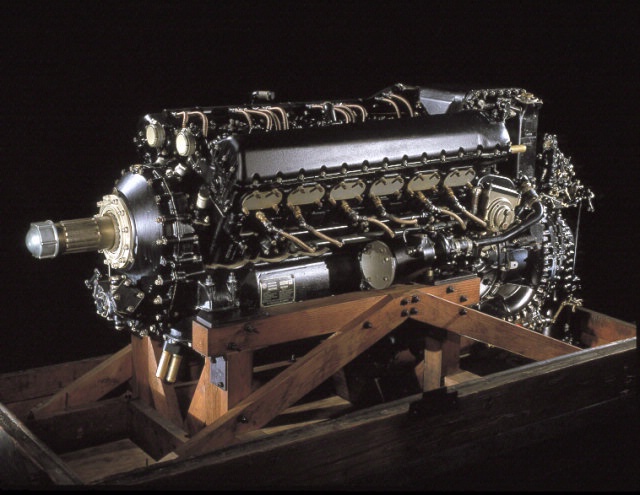
Object Details
Manufacturer
Pratt & Whitney
Physical Description
Type: Turbofan
Thrust: 75,616 N (17,000 lb) at 6,650 rpm
Compressor: 2-stage fan, 6-stage low pressure and 7-stage high pressure axial
Combustor: 8 combustion chambers
Turbine: Single-stage high pressure and 3-stage low pressure axial
Weight: 1,882 kg (4,150 lb)
Summary
Pratt & Whitney Aircraft began development of its first production turbofan, the JT3D, in the late 1950s, by taking advantage of the service-proven JT3 (J57) gas generator, and adding a two-stage front fan. The JT3D made its first flight on a Boeing 707-120 on June 22, 1960, and powered the Boeing 707-120B, Boeing 720, and Douglas DC-8-50 airliners.
Although initially funded by the U.S. Air Force as the T33, the JT3D is an historic commercial jet transport engine. It was Pratt & Whitney's first commercial production turbofan, and fended off competition from the Rolls Royce Conway, which had a lower bypass ratio. It only required a simple modification to existing JT3 engines, which could be carried out by operators using a manufacturer provided kit. The conversion had a marginal effect on weight, but increased thrust by 35 percent, reduced fuel consumption by 15 to 22 percent, and cut takeoff noise by 10 dB.
Credit Line
Gift of Pratt & Whitney Aircraft
Date
Circa late 1950s
Inventory Number
A19721331000
Restrictions & Rights
Usage conditions apply
Type
PROPULSION-Turbines (Jet)
Materials
Steel, Aluminum, Inconel, Stainless Steel, Magnesium, Preservative coating, Plastic, Textile
Dimensions
Length 346 cm (136.3 in.), Diameter 135 cm (53.1 in.)
Country of Origin
United States of America
See more items in
National Air and Space Museum Collection
Data Source
National Air and Space Museum
Link to Original Record
Record ID
nasm_A19721331000