
Object Details
Manufacturer
Pratt & Whitney
Physical Description
Type: Turbojet
Thrust: 66,720 N (15,000 lb) at 8,200 rpm
Compressor: 9-stage high pressure and 6-stage low pressure axial
Combustor: Cannular
Turbine: Single-stage high pressure and 2-stage low pressure axial
Weight: 2,205 kg (4,860 lb)
Summary
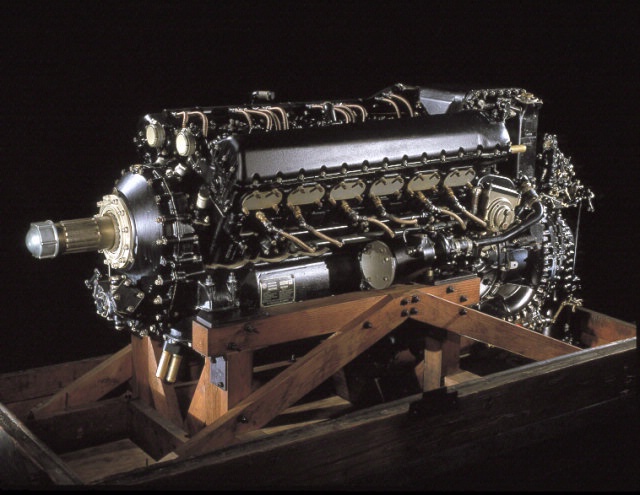
The X-176 Pratt & Whitney turbojet engine was the prototype of the famous J57 series, the first successful twin-spool turbine engine and the first production aircraft engine in the 10,000 lb (44,480 N) thrust class. The early 1948 design was superceded by the "wasp-waisted" configuration and retired in August 1950.
Leonard S. Hobbs, Vice President for Engineering of United Aircraft Corporation, was awarded the 1953 Collier Trophy for his leading part in conceiving and developing the J57.
Among the military aircraft powered by the J57 were the Boeing B-52, North American F-100 Super Sabre, McDonnell F-101 Voodoo, Convair F-102 Delta Dagger, Douglas F4D Skyray, Douglas A3D Skywarrior, Ling-Temco-Vought F8U Crusader, Lockheed U-2 , and Northrop SM-62 Snark. The JT3 commercial version of the engine powered the Boeing 707-120, Boeing 720, and Douglas DC-8-10.
This engine powered the F8U-1 Crusader, the first supersonic U.S. Navy carrier-based aircraft.
Credit Line
Transferred from the General Services Administration, Disposal Division, U.S. Naval Supply Center, San Diego, California
Date
Circa 1955
Inventory Number
A19710059000
Restrictions & Rights
Usage conditions apply
Type
PROPULSION-Turbines (Jet)
Dimensions
Length 680 cm (267.6 in.), Diameter 101 cm (39.8 in.)
Country of Origin
United States of America
See more items in
National Air and Space Museum Collection
Data Source
National Air and Space Museum
Link to Original Record
Record ID
nasm_A19710059000