
Object Details
Manufacturer
Pratt & Whitney
Physical Description
Type: Turbojet
Thrust: 32,248 N (7,250 lb) at 11,000 rpm
Compressor: Single-stage centrifugal
Combustor: 9 combustion chambers
Turbine: Single-stage axial
Weight: 998 kg (2,200 lb)
Summary
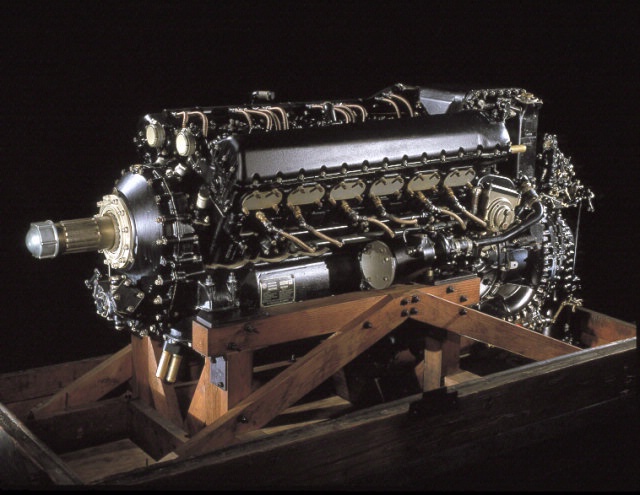
To enter post-World War II jet engine production, Pratt & Whitney licensed production of the Rolls-Royce Nene engine. Converted to American standards, the resulting J42 Turbo-Wasp was first delivered to the Navy in 1948 for installation in the Grumman F9F-2 Panther.
Realizing the need for a higher-powered engine, Rolls-Royce and Pratt & Whitney Aircraft worked together on a centrifugal-flow turbojet with a 30 percent power increase with no significant increase in overall engine size. Known in England as the Tay and in the U.S. as the J48 Turbo-Wasp, and publicly introduced in 1950, the 27,800 N (6,250 lb) thrust engine was then the most powerful engine flying in either country. Pratt & Whitney added water injection and an afterburner of its own design, which provided substantial power increases for short periods during combat.
The J48-P-8C powered the Grumman F9F-6 Cougar. Other models powered the Grumman F9F-5 Panther, the North American F-93A and Lockheed F-94C Starfire.
Credit Line
Transferred from the U.S. Navy, Naval Surface Warfare Center, Dahlgren, Virginia
Date
Circa 1952
Inventory Number
A19750601001
Restrictions & Rights
Usage conditions apply
Type
PROPULSION-Turbines (Jet)
Dimensions
Overall: 2200lb. (997.9kg)
Other: 9 ft. 2 in. × 4 ft. 2 in. (279.4 × 127cm)
Storage: 158.7 × 297.2 × 165.1cm (5 ft. 2 1/2 in. × 9 ft. 9 in. × 5 ft. 5 in.)
Country of Origin
United States of America
See more items in
National Air and Space Museum Collection
Data Source
National Air and Space Museum
Link to Original Record
Record ID
nasm_A19750601001