
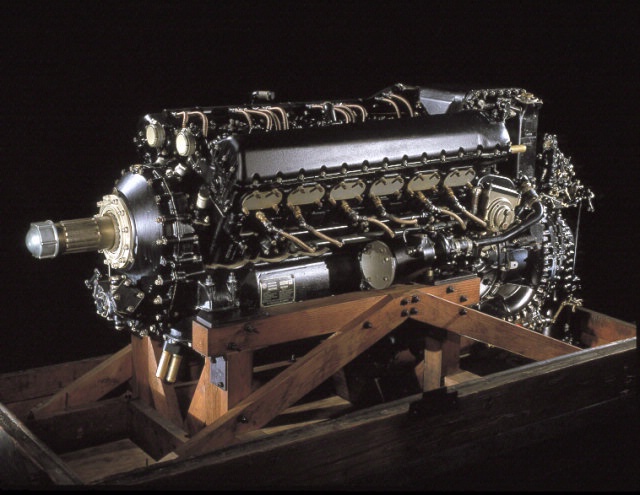
Object Details
Manufacturer
Pratt & Whitney
Physical Description
Type: Turbofan, afterburner
Thrust: 105,996 N (23,830 lb)
Fan: Bypass ratio 0.36:1, 3-stage
Compressor: 10-stage high pressure axial
Combustor: Single chamber
Turbine: 2-stage high pressure axial, 2-stage low pressure axial
Weight: 1,377 kg (3,035 lb)
Summary
Pratt & Whitney won a 1970 U.S. Air Force competition to design the engine for the service's next generation fighter, the F-15 Eagle. The F100-PW-100 first flew in July 1972 and entered service with the F-15A and B aircraft in 1974. After a brief period of development problems, Pratt & Whitney and the Air Force turned the program into one known for performance, reliability and safety. The F100-PW-100 produces about eight pounds of thrust for every pound of its weight, a very important characteristic for high-performance military aircraft that require fast acceleration and great maneuverability.
Continuous improvement of the F100 resulted in the later 200 series engines, which include technology upgrades from the later F119 and F135 engine programs. The F100 series also powers the F-16 Fighting Falcon. Vigorous export sales and overseas licensed production have ensured that F100 engines powering both F-15s and F-16s across the world have accumulated more than 16 million flight hours.
Credit Line
Transferred from the U.S. Air Force, Kelly AFB, Texas
Date
Circa 1973
Inventory Number
A19900276000
Restrictions & Rights
Usage conditions apply
Type
PROPULSION-Turbines (Jet)
Materials
Steel, Stainless Steel, Rubber, Inconel, Aluminum, Plastic, Titanium
Dimensions
Length 486 cm (191 in.), Diameter 118 cm (46.5 in.)
Country of Origin
United States of America
See more items in
National Air and Space Museum Collection
Data Source
National Air and Space Museum
Link to Original Record
Record ID
nasm_A19900276000