
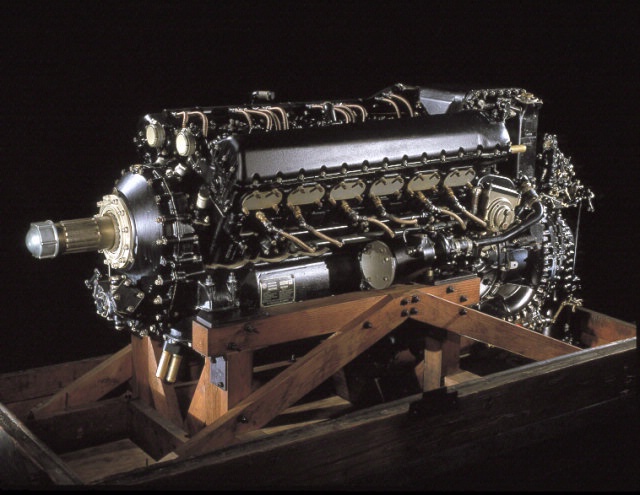
Object Details
Manufacturer
Pratt & Whitney Canada (Longueuil, Quebec)
Physical Description
Type: Turboshaft
Power Rating: 1,398 kw (1,875 shp) at 6,600 rpm
Compressor: 3-stage axial and 1-stage centrifugal
Combustor: Reverse-flow annular
Turbine: Single-stage axial high pressure turbine and single-stage axial power turbine
Weight: 3,522 kg (7,765 lb)
Mounted inside part of a plane cutaway
Summary
Pratt & Whitney Canada began development of small gas turbines in the mid-1950s. Experience was first gained with the JT12 turbojet, produced by P&WA in the United States for aircraft such as the North American Sabreliner. In the late-1950s, following a survey of small aircraft manufacturers, P&WC decided to produce the PT6 free turbine engine, for both turboshaft and turboprop applications.
Initial commercial success was in the turboprop powered, fixed-wing Beech King Air, which first flew in February 1964. In 1967, foreseeing that multiple-turboshaft helicopter installations promised increased power and flight safety, P&WC began design of an engine consisting of two PT6 power sections coupled to a single gearbox. The PT6T-3 TwinPac became operational in 1970, first flying in the Bell 212 and UH-1N Twin Huey helicopter family.
This uprated TwinPac is installed in the nose cowling of a re-engined Sikorsky S-58T helicopter, and provided an extended operational envelope and improved payload capability over the original piston-powered version.
Credit Line
Gift of United Technologies Corporation, Sikorsky Aicraft Division
Date
Circa 1974
Inventory Number
A19761342000
Restrictions & Rights
Usage conditions apply
Type
PROPULSION-Turbines (Jet)
Materials
Non-Magnetic White Metals
Fiberglass
Ferrous Alloy
Rubber Coated Fabric
Rubber
Plastic
Paint
Dimensions
3-D: 182.2 × 236.2 × 193cm (5 ft. 11 3/4 in. × 7 ft. 9 in. × 6 ft. 4 in.)
Country of Origin
Canada
See more items in
National Air and Space Museum Collection
Data Source
National Air and Space Museum
Link to Original Record
Record ID
nasm_A19761342000