
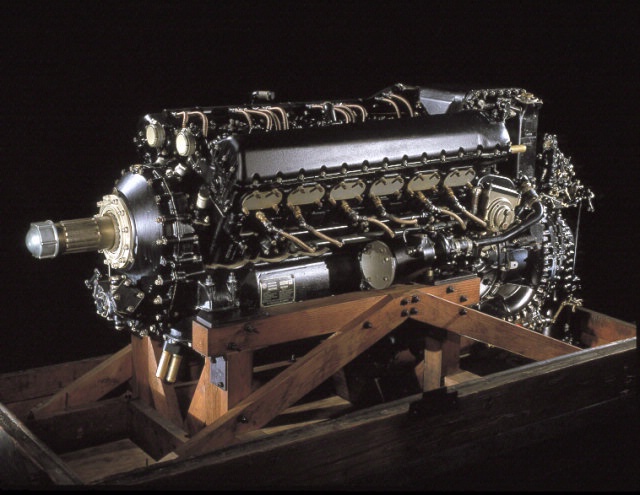
Object Details
Manufacturer
Packard Motor Car Company (Detroit, Michigan)
Physical Description
Type: Turbofan
Thrust: 44,480 N (10,000 lb) at 11,780 rpm
Fan: Single-stage
Compressor: Single-stage supersonic axial and single-stage mixed-flow
Combustor: Multiple chambers
Turbine: 2-stage air-cooled compressor drive, 2-stage air-cooled fan drive
Weight: 1,361 kg (3,000 lb)
Summary
At the end of World War II, Packard replaced production of Rolls-Royce Merlin engines with automobiles, and the company’s aircraft engine interests focused on experimental work with gas turbines at a leased Army Air Forces-owned plant in Toledo, Ohio. Those facilities, which included a full-scale engine component wind tunnel, permitted detailed study of the aerodynamic and thermodynamic problems of jet engines.
Jet engine development began in 1945 under contract with the Air Materiel Command at Wright Field, and in two years became the sole activity of the Packard Aircraft Engine Division. The Packard XJ49-V-1 was the first turbofan engine developed in the U.S. In 1947, the engine ran once with apparently good results. However, the remaining work required for complete development of a successful flight engine was considerable, and the Air Force terminated the contract in January 1948. With that cancellation, Packard’s long association with the aircraft engine business ended.
Credit Line
Transferred from the U.S. Air Force Museum, Wright-Patterson AFB, Ohio
Date
Circa 1948
Inventory Number
A19600243000
Restrictions & Rights
Usage conditions apply
Type
PROPULSION-Turbines (Jet)
Materials
Steel, Aluminum, Magnesium, Textile, Rubber, Paint
Dimensions
Length 442 cm (174.0 in.), Diameter 135 cm (53.0 in.)
Country of Origin
United States of America
See more items in
National Air and Space Museum Collection
Data Source
National Air and Space Museum
Link to Original Record
Record ID
nasm_A19600243000