
Object Details
Manufacturer
Packard Motor Car Company (Detroit, Michigan)
Physical Description
Type: Reciprocating, 9 cylinders, radial, air-cooled
Power rating: 168 kW (225 hp) at 1,950 rpm
Displacement: 16.1 L (982 cu in.)
Bore and Stroke: 122 mm (4.8 in.) x 152 mm (6.0 in.)
Weight: 232 kg (510 lb)
Summary
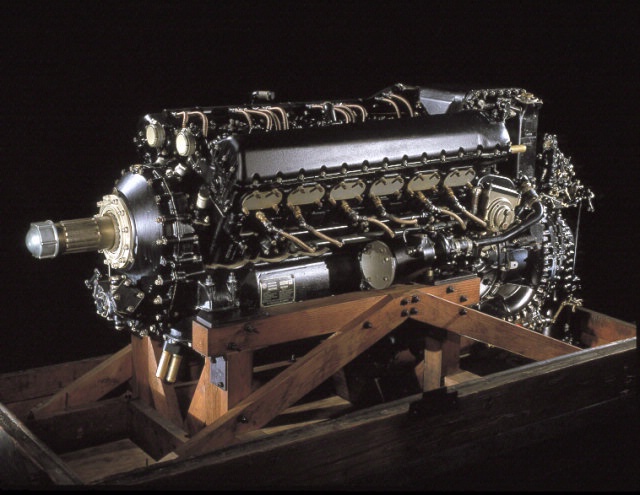
The Packard Diesel engine was designed and built by the Packard Motor Car Company, and won the 1931 Collier Trophy. The objective was to achieve greater safety and economy through use of heavy oil (furnace oil) as fuel. However, the engine also reputedly suffered from smell and vibration.
Issued Type Certificate No. 43 by the Department of Commerce in March 1930; the engine was publicly shown for the first time during the Detroit Aircraft Show in April 1930. Installed in a Bellanca aircraft, it set a world's non-refueled duration flight record of 84.5 hours in May 1931 at Jacksonville, Florida.
This artifact is the original Packard Diesel engine, the first compression ignition, oil-burning engine flown. The DR-980 powered such aircraft as the: Stinson SM-1DX Detroiter; Packard-Bellanca Pacemaker; Verville Air Coach; Ford 11-AT-1 Trimotor; Goodyear Defender airship; Towle FA-3 Flying boat; Stewart M-2 Monoplane; Waco Taper Wing; and Consolidated XPT-8A aircraft.
Credit Line
Gift of the Packard Motor Car Company
Date
Circa 1930
Inventory Number
A19320007000
Restrictions & Rights
Usage conditions apply
Type
PROPULSION-Reciprocating & Rotary
Materials
HAZ MAT: Cadmium Plating
Aluminum
Steel
Paint
Copper Alloy
Rubber
Chrome Plating
Nickel Plating
Dimensions
Diameter 116 cm (34.7 in.), Length 87.3 cm (34.4 in.)
Country of Origin
United States of America
See more items in
National Air and Space Museum Collection
Data Source
National Air and Space Museum
Link to Original Record
Record ID
nasm_A19320007000