
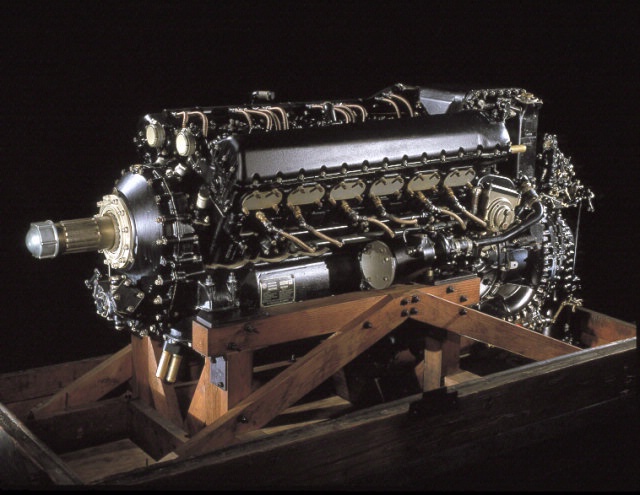
Object Details
Manufacturer
Packard Motor Car Company (Detroit, Michigan)
Physical Description
Type: Reciprocating, 12 cylinders, V-type, geared drive, liquid-cooled
Power rating: 596.6 kW (800 hp) at 2,000 rpm
Displacement: 41.6 L (2,539.55 cu in.)
Bore and Stroke: 162 mm (6.375 in.) x 165 mm (6.5 in.)
Weight: 646.4 kg (1,425 lb)
Summary
The Packard Motor Car Company of Detroit, Michigan produced the world’s first quantity-production 12-cylinder automobile in in 1916, and belief in that engine carried over to aviation in the following year. Particularly beginning with lessons learned with the World War I era Liberty engines, Packard began development of 12-cylinder aircraft engines in 1923 that would better fully meet requirements of the Army and Navy, with a resulting great step forward made in decreasing the weight per horsepower.
The engines in the Packard 2500 series were built in direct drive and geared types. The development of the 3A-2500, like its predecessors the 1A-2500 and 2A-2500, was sponsored by both the Army and the Navy. By 1927, the Model 2500 was the most powerful standard aircraft engine in existence. It powered the Huff-Daland XHB-1 Cyclops, the Martin 3-Purpose Aircraft, Dornier Superwal, and Boeing PB-1. The Packard 3A-2500 was type certificated for commercial use in January 1929.
Credit Line
Gift of Florence Air and Missile Museum
Date
1926
Inventory Number
A19660004000
Restrictions & Rights
CC0
Type
PROPULSION-Propellers & Impellers
Materials
Aluminum, Steel, Paint, Preservative coating, Rubber, Brass, Textile, Copper
Dimensions
Height 106.9 cm (42.1 in.), Length 177.2 cm (69.75 in.), Width 74.3 cm (29.25 in.)
Country of Origin
United States of America
See more items in
National Air and Space Museum Collection
Data Source
National Air and Space Museum
Link to Original Record
Record ID
nasm_A19660004000