
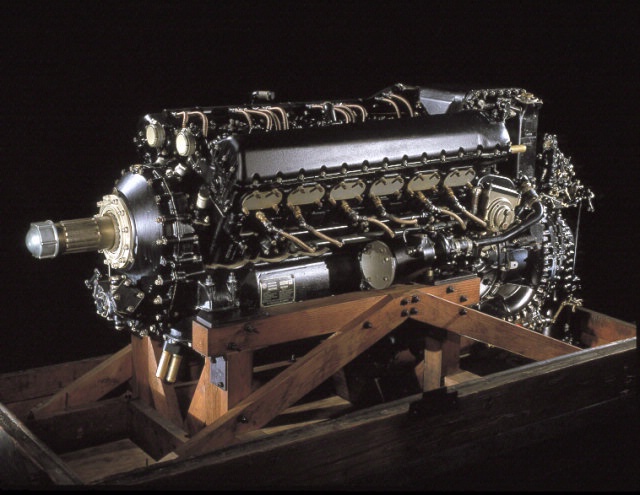
Object Details
Manufacturer
Northrop-Hendy
Physical Description
Type: Turboprop
Power Rating: 1,790 kW (2,400 bhp) at 10,000 rpm
Compressor: 18-stage axial
Combustor: Unknown
Turbine: 4-stage axial
Summary
In 1939, Northrop Aircraft undertook company-funded preliminary design of a turboprop engine. A joint Army-Navy contract was awarded in 1941 for detailed design and analysis of a 2,500 shp (1,864 kW) engine and fabrication of a compressor for it. A contract amendment later added construction of two complete 3,800 shp (2,834 kW) engines.
Having little time or space for fabricating parts, Northrop joined with the Joshua Hendy Iron Works in 1944 to form the Northrop-Hendy Company. The engine did not reach its design performance due largely to low compressor and turbine efficiencies, and a compressor failure destroyed the first engine and terminated testing. Following the 1945 cancellation of the Navy contract, the Army continued with the testing of this second engine until it also partially failed. Development was then discontinued.
Although potential high efficiency encouraged Northrop to continue turboprop engine development, possibly as a backup for the Boeing XB-52 bomber, the later XT37 endeavor was similarly unsuccessful.
Credit Line
Transferred from the U.S. Navy, Naval Air Station, Norfolk, Virginia
Date
Circa 1945
Inventory Number
A19710103000
Restrictions & Rights
Usage conditions apply
Type
PROPULSION-Turbines (Jet)
Materials
Steel, Aluminum, Brass, Ceramic, Magnesium, Copper, Inconel, Paint
Dimensions
Depth 160 cm (63 in.), Width 104 cm (41 in.), Length 236 cm (93 in.)
Country of Origin
United States of America
See more items in
National Air and Space Museum Collection
Data Source
National Air and Space Museum
Link to Original Record
Record ID
nasm_A19710103000