
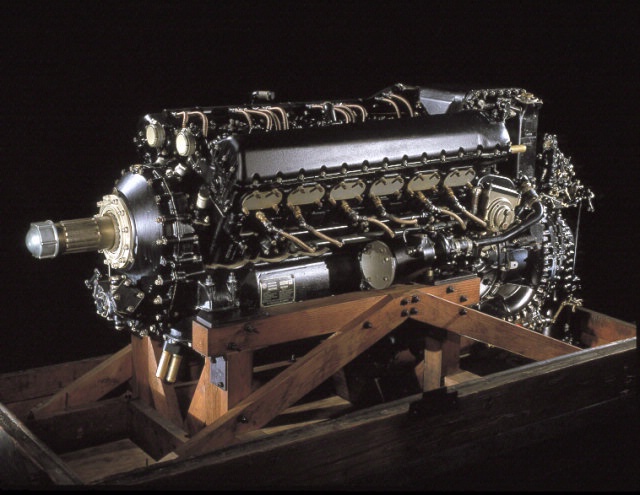
Object Details
Manufacturer
Naval Aircraft Factory
Designer
Wright Aeronautical
Physical Description
Type: Reciprocating, 9 cylinders, radial, air-cooled
Power rating: 336 kW (450 hp) at 2,250 rpm
Displacement: 16 L (975 cu in)
Bore and Stroke: 127 mm (5.0 in.) x 140 mm (5.5 in.)
Weight: 321 kg (707 lb)
Summary
Charles Lawrance, originally a race car engine designer, built his first air-cooled aircraft engine in 1921 for a Navy contract. The 149 kW (200 hp) J-1 satisfied a Navy need for a compact lightweight engine for use on aircraft carriers and not plagued with water leakage problems.
Progressing through design stages, it used advanced engineering features such as sodium cooled exhaust valves and aluminum cylinder heads. Despite its higher initial cost relative to other engines available at the time, its reliability and lower operating cost resulted in widespread use among many aircraft manufacturers.
The most famous Wright Whirlwind application was the 1927 New York-to-Paris flight of Charles Lindbergh. In 1928, Charles Lawrance was awarded the Collier Trophy for the outstanding performance of his engines based on records set in 1927. This artifact was built by the Naval Aircraft Factory in Philadelphia, Pennsylvania between 1940 and 1943. It is believed to have powered the Interstate XTD3R-1 prototype assault drone.
Credit Line
Gift of San Jose State University
Date
Circa World War II
Inventory Number
A19860280000
Restrictions & Rights
Usage conditions apply
Type
PROPULSION-Reciprocating & Rotary
Materials
Possible HAZ MAT: Cadmium
Possible HAZ MAT: Asbestos
HAZ MAT: Lead Alloy
Aluminum Alloy
Copper Alloy
Ferrous Alloy
Paints
Cork
Plastics
Dimensions
Other (Diameter x Length): 3 ft. 9 1/4 in. × 3 ft. 5 13/16 in. (114.9 × 106.2cm)
Overall: 707lb. (320.7kg)
Country of Origin
United States of America
See more items in
National Air and Space Museum Collection
Data Source
National Air and Space Museum
Link to Original Record
Record ID
nasm_A19860280000