
Object Details
Manufacturer
Nakajima Hikoki K. K.
Physical Description
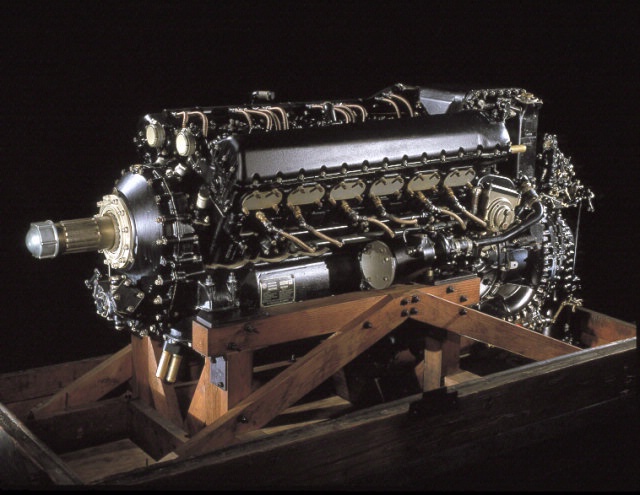
Type: Reciprocating, 14 cylinders, 2 rows, radial, air-cooled
Power rating: 1,394 kW (1,870 hp) at 2,600 rpm
Displacement: 44.49 L (2,715 cu. in.)
Bore and Stroke: 155 mm (6.1 in.) x 170 mm (6.69 in.)
Weight: Not available
Manufactured circa World War II
Has baffles; missing data plate; some cooling fins bent
Summary
Nakajima provided Japan with its first large radials by building licensed Bristols beginning in the late 1920s, and Gnome-Rhone engines beginning in 1936. Nakajima built three 14-cylinder radial engines. The pre-World War II Mamoru possibly shares characteristics with the Pratt & Whitney R-2000. It was the most powerful 14-cylinder engine ever built, with versions at 1,790 kW (2,400 hp) and one of the largest at 44.49 L (2,715 cu. in.).
This engine is of the type that powered the World War II Japanese Nakajima B6N Navy Carrier Attack Bomber Tenzan Type 11 (Allied Code Name Jill). Between 1941 and 1944, 200 engines of all Mamoru series were manufactured, but these were generally not considered successful. After 1945, the company became Fuji, building airframes only.
Credit Line
Transferred from the U.S. Navy
Date
Circa World War II
Inventory Number
A19710933000
Restrictions & Rights
CC0
Type
PROPULSION-Reciprocating & Rotary
Materials
Aluminum, Steel, Rubber, Copper, Ceramic, Magnesium, Wood
Dimensions
Approximate: 162.56 x 226.06 x 167.64cm (5ft 4in. x 7ft 5in. x 5ft 6in.)
3-D (Weight on stand): 1230.2kg (2712lb.)
Country of Origin
Japan
See more items in
National Air and Space Museum Collection
Data Source
National Air and Space Museum
Link to Original Record
Record ID
nasm_A19710933000