
Object Details
Manufacturer
Nakajima Hikoki K. K.
Physical Description
Type: Reciprocating, 18 cylinders, W-type, liquid cooled, supercharged
Power rating: 1,491 kW (2,000 hp) at (Unknown) rpm
Displacement: 51.1 L (3,116 cu in.)
Bore and Stroke: 146 mm (5.74 in.) x 170 mm (6.69 in.)
Weight: 431 kg (950 lb)
Summary
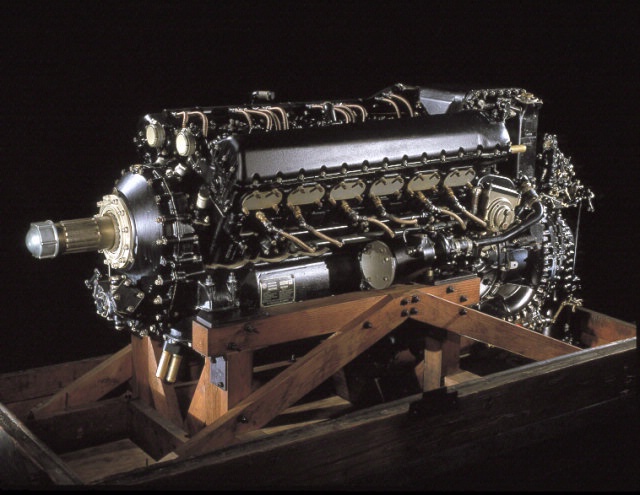
In 1934, the Japanese Navy began development of an 18-cylinder, W-type engine known as the 671 kW (900 shp) Model 94, likely a derivative of the French Lorraine aircraft engine. Later, more powerful versions of this engine were undertaken, including the YE2A, which started development around 1937-38.
The YE2A was designed for remote installation within an aircraft fuselage, the purpose being aircraft streamlining and speed. Designed for a pusher installation, the engine was experimentally tested, but probably never test flown.
This Nakajima engine resembles the YE2A, but was designed for tractor installation. It also resembles a version of a Hispano-Suiza engine, which had been studied by the Yokosuka Naval Air Arsenal. Mitsubishi had acquired a license in 1935 for Hispano-Suiza engines, further suggesting how the Japanese might have acquired these engines. The intended airframe application for the engine is unknown.
Along with other Japanese engines, this artifact was collected for the purpose of technical evaluation.
Credit Line
Believed to have been transferred from the U.S. Army Air Forces, Wright Field, Dayton, Ohio
Date
Circa World War II
Inventory Number
A19670127000
Restrictions & Rights
Usage conditions apply
Type
PROPULSION-Reciprocating & Rotary
Materials
Aluminum Alloys
Ferrous Alloys
Copper Alloys
Adhesive Tape
Plastics
Wood
Paper
Adhesive
Dimensions
3-D: 223.5 × 97.2 × 121.9cm (7 ft. 4 in. × 3 ft. 2 1/4 in. × 4 ft.)
Storage (Stand): 8 1/4 × 4 ft. (244.5 × 121.9cm)
3-D: 430.9kg (950lb.)
Country of Origin
Japan
See more items in
National Air and Space Museum Collection
Data Source
National Air and Space Museum
Link to Original Record
Record ID
nasm_A19670127000