
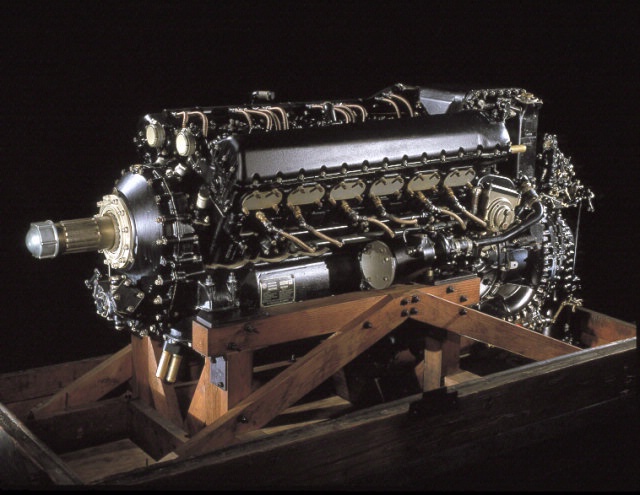
Object Details
Manufacturer
Nakajima Hikoki K. K.
Physical Description
Type: Reciprocating, 14 cylinders, 2 rows, radial, air-cooled
Power rating: 858 kW (1,150 hp) at 2,700 rpm
Displacement: 27.9 L (1,704 cu in.)
Bore and Stroke: 130 mm (5.1 in.) x 150 mm (5.9 in.)
Weight: 585 kg (1,289 lb)
Summary
The Nakajima Ha 105 began development as a transitional engine between the Ha 25 and the Ha 115, both of which were mass produced. Specifically built for very low fuel consumption, only four are known to have been built.
In January 1940, the Asahi Press requested the Aeronautical Research Institute of the University of Tokyo to design a long-distance record-breaking aircraft with a range exceeding 15,000 km (9,321 miles) and minimum cruising speed of 300 km/h (186 mph). With approval of the Japanese Army, the project received the designation A-26 (A referring to Asahi and 26 for the Japanese year, 2600 (A.D. 1940)).
The aircraft was eventually powered by the higher powered Ha 115 Toku engines. With the onset of World War II, the objective changed to making the plane a long-range communication aircraft, and redesignated Tachikawa Ki-77 Army Experimental Long-range Research Plane. Two prototype aircraft were built before the War ended.
Credit Line
Transferred from the U.S. Army Air Forces
Date
June 1941
Inventory Number
A19670084000
Restrictions & Rights
CC0
Type
PROPULSION-Reciprocating & Rotary
Materials
Steel, Aluminum, Brass, Wood, Textile, Rubber, Magnesium, Paint, Ceramic
Dimensions
Length 147 cm (57.9 in.), Diameter 115.cm (45.25 in.)
Country of Origin
Japan
See more items in
National Air and Space Museum Collection
Data Source
National Air and Space Museum
Link to Original Record
Record ID
nasm_A19670084000