
Object Details
Designer
Joseph J. Murray
Manufacturer
Murray-Willat Company
Physical Description
Type: Rotary, 6 cylinders, air-cooled, 2-stroke, supercharged
Power rating: 22.4 kW (30 hp) at 1,200 rpm
Displacement: 2.4 L (146 cu in.)
Bore and Stroke: 75 mm (2.95 in.) x 90 mm (3.54 in.)
Weight: 60 kg (132.3 lb)
Summary
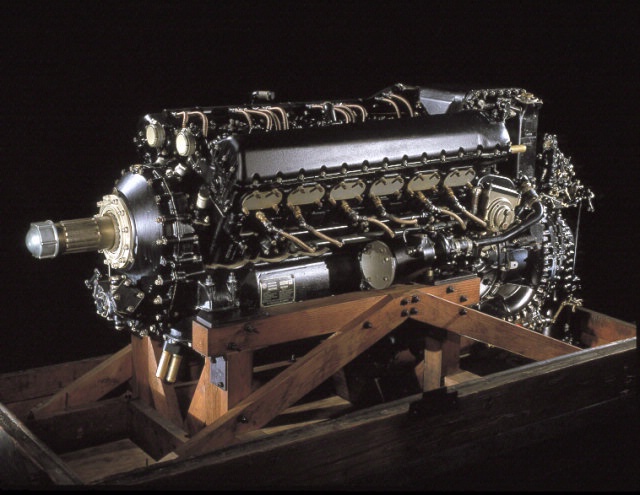
The Murray engine is the earliest American supercharged engine still in existence. In 1911, Joseph J. Murray began design of air-cooled, valveless, 2-stroke, supercharged rotary engines, with the first model tested early in 1912. The engines were developed by the Murray-Willat Company, and built by the American Motors and Aviation Company, where Murray briefly served as Secretary-Treasurer. Murray engines were built through 1914.
This model followed the earlier 18.6 kW (25-hp) and 52 kW (70-hp) engines, and used an improved vane-type supercharger. Murray’s engines never flew, but this artifact was installed in a Murray-designed monoplane that served as a prop in two early movies produced at Mack Sennett’s Keystone Studios, Saved by Wireless and Civilization. The aircraft was heavily damaged during production of Civilization and apparently not used again. The artifact is mounted on its original metal test stand.
Credit Line
Gift of Miss Vera C. Murray
Date
1913
Inventory Number
A19640635000
Restrictions & Rights
Usage conditions apply
Type
PROPULSION-Reciprocating & Rotary
Dimensions
Diameter 66 cm (25.98 in.)
Country of Origin
United States of America
See more items in
National Air and Space Museum Collection
Location
Steven F. Udvar-Hazy Center in Chantilly, VA
Hangar
Boeing Aviation Hangar
Data Source
National Air and Space Museum
Link to Original Record
Record ID
nasm_A19640635000