
Object Details
Manufacturer
NASA - Jet Propulsion Laboratory
Summary
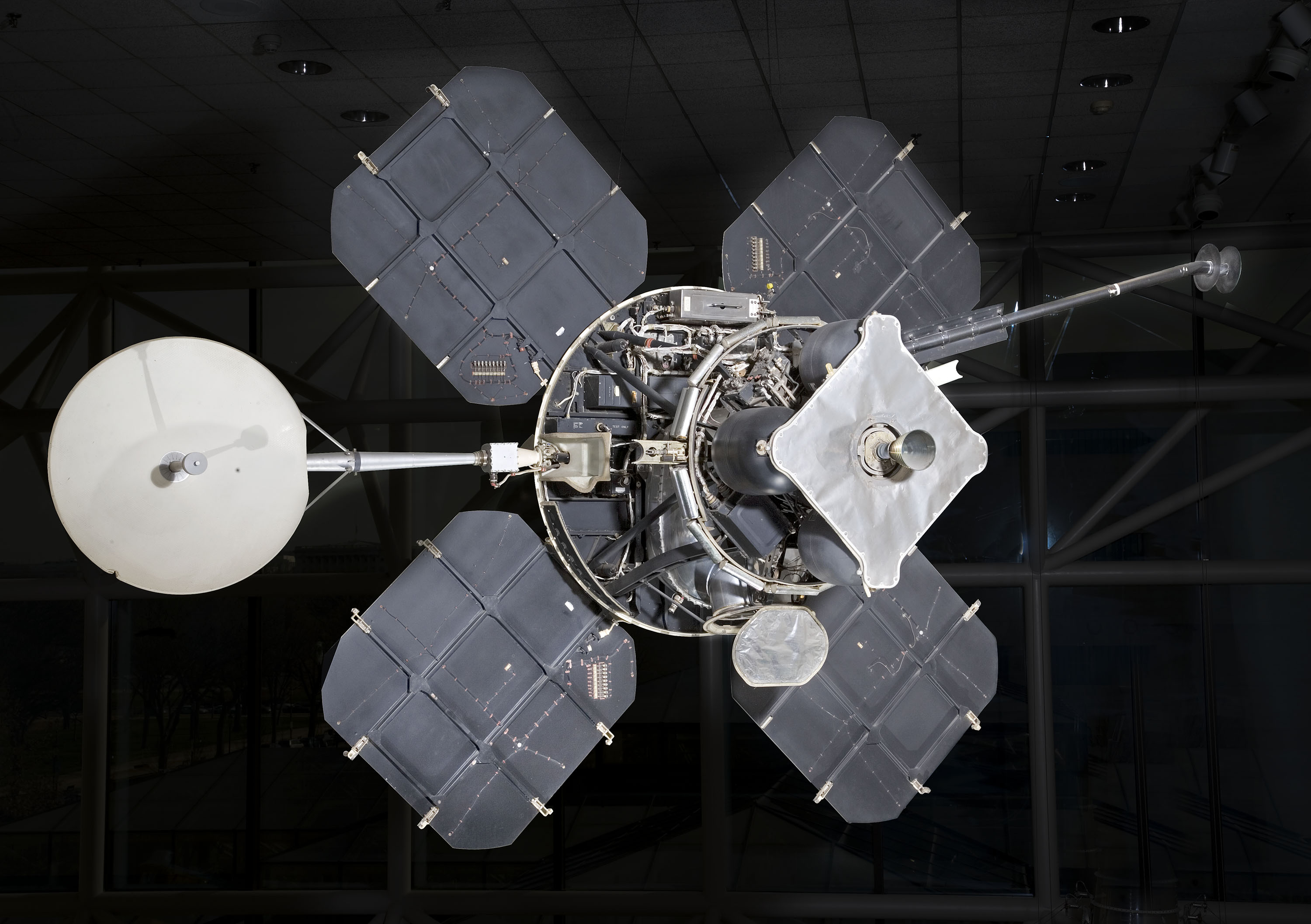
This is a 1/24th scale model of Mariner 2, the space probe that on December 14, 1962, radioed back to Earth useful scientific information from another planet, in this case Venus, for the first time. At that time Mariner 2, with its six scientific instruments, passed within 34,800 kilometers (21,600 miles) of Venus. Data from the spacecraft indicated that Venus was very hot and had no measureable magnetic fields or radiation belts. On the way to Venus, Mariner 2's instruments detected and measured for the first time radiation levels, magnetic fields, and dust of interplanetary space. Contact with Mariner 2 was lost on January 2, 1963 and it remains in orbit around the Sun.
Transferred from the National Aeronautics and Space Administration, Jet Propulsion Laboratory.
Long Description
"Before Mariner II lost its sing-song voice, it produced 13 million data words of computer space lyrics to accompany the music of the spheres."
Harold J. Wheelock, composer, 1963
Mariner 2
As with other space exploration, planetary exploration took shape as a race between the United States and the Soviet Union. As a first objective, both countries looked to send a spacecraft close to Venus. The Soviets launched a spacecraft (Venera 1) first, but the U.S. achieved the first success: Mariner 2 became the first spacecraft to reach the planet. The Mariner 2 mission revealed the tension between science and long-standing popular beliefs in describing Venus in the early space age.
Scientists in both the United States and the Soviet Union recognized the importance of Venus in understanding the solar system. But the planet, widely recognized as the evening and the morning star, long had enchanted humans-and all the more so after astronomers realized that a mysterious cloak of clouds shrouded the surface from view. In planetary terms and in the public mind, Venus stood as a near twin to Earth, nearly identical in size, mass, and gravitation but its impenetrable veil of clouds stimulated speculation on what might lie below.
Incomplete scientific knowledge gave rise to myriad speculations about Venus, including the idea that life existed there. In the first half of the twentieth century a popular theory held that as the sun cooled over the millennia, the inner planets of the solar system, in turn, provided a haven for life. In this cycle, Earth now harbored life, Mars once had been habitable, and Venus just was starting to evolve. In this view, beneath the clouds, Venus might possess a warm, watery world, suitable to aquatic and amphibious life. As late as 1963, a publication from the Jet Propulsion Laboratory about the Mariner 2 mission; noted that "It was reasoned that if the oceans of Venus still exist, then the Venusian clouds may be composed of water droplets," and "if Venus were covered by water, it was suggested that it might be inhabited by Venusian equivalents of Earth's Cambrian period of 500 million years ago, and the same steamy atmosphere could be a possibility." These conceptions, still prevalent in the early 1960s, first took hold during the earliest years of the twentieth century. While most scientists questioned them, it took the data returned from Mariner 2 to push them out of popular and even NASA publications.
Mariner 2 launched successfully on August 27, 1962 (Mariner 1 failed at launch the previous year). A 450-pound vehicle, it carried six scientific instruments, a two-way radio, a solar-power system, and assorted electronic and mechanical devices. A ground control team (numbering roughly 75) worked from NASA's Jet Propulsion Laboratory in Pasadena, California.
Mariner 2 made its closest approach to Venus on December 14, 1962, after a 108-day journey from Earth, coming within 21,648 miles of the planet. Its instruments provided information on the nature of Venus's atmosphere and surface as well as interplanetary space. A microwave radiometer measured the temperatures of both the planet's surface and its upper atmosphere, and found that the surface of Venus was indeed very hot; around 800 degrees F. A magnetometer revealed that the planet had no appreciable magnetosphere. A high-energy radiation experiment discerned that radiation levels in interplanetary space were non-lethal-that an astronaut could survive a four month interplanetary voyage to Venus. NASA lost contact with Mariner 2 on January 2, 1963, and it is now in orbit around the Sun.
Credit Line
Transferred from the National Aeronautics and Space Administration
Inventory Number
A19751493000
Restrictions & Rights
Usage conditions apply
Type
MODELS-Uncrewed Spacecraft & Parts
Materials
Plastic, mesh wire, steel
Dimensions
Approximate: 45.72 x 30.48cm (1ft 6in. x 1ft)
Country of Origin
United States of America
See more items in
National Air and Space Museum Collection
Data Source
National Air and Space Museum
Link to Original Record
Record ID
nasm_A19751493000