Skip to main content Skip to main navigation
heart-solid My Visit Donate
Home Smithsonian Institution IK development site for ODI
Press Enter to activate a submenu, down arrow to access the items and Escape to close the submenu.
    • Overview
    • Museums and Zoo
    • Entry and Guidelines
    • Museum Maps
    • Dine and Shop
    • Accessibility
    • Visiting with Kids
    • Group Visits
    • Overview
    • Exhibitions
    • Online Events
    • All Events
    • IMAX & Planetarium
    • Overview
    • Topics
    • Collections
    • Research Resources
    • Stories
    • Podcasts
    • Overview
    • For Caregivers
    • For Educators
    • For Students
    • For Academics
    • For Lifelong Learners
    • Overview
    • Become a Member
    • Renew Membership
    • Make a Gift
    • Volunteer
    • Overview
    • Our Organization
    • Our Leadership
    • Reports and Plans
    • Newsdesk
heart-solid My Visit Donate

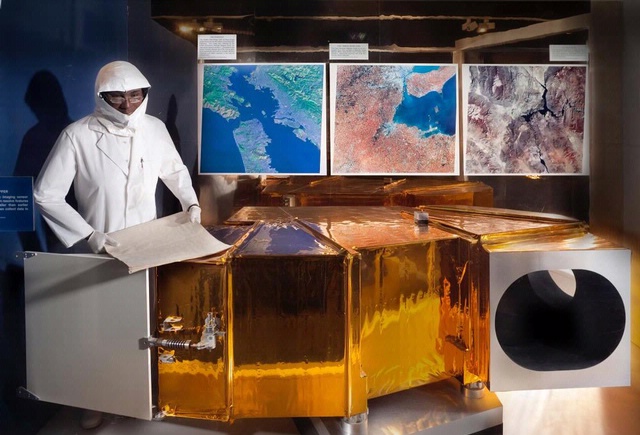
Model, Communications Satellite, INTELSAT VI

Air and Space Museum

There are restrictions for re-using this image. For more information, visit the Smithsonian's Terms of Use page .
International media Interoperability Framework
IIIF provides researchers rich metadata and media viewing options for comparison of works across cultural heritage collections. Visit the IIIF page to learn more.
View manifest View in Mirador Viewer

    Object Details

    Manufacturer

    Penwal Industries

    Summary

    In 1965, the International Telecommunications Satellite Organization (Intelsat) launched the Early Bird satellite (also known as Intelsat 1). This event marked the beginning of day-to-day, operational communications via space and established Intelsat, a consortium of tens of nations, as the primary vehicle for providing this new capability. Over the next two decades, Intelsat and its satellites helped change the way communications flowed around world--from telephone calls, to television, and data.
    A total of six Intelsat VI satellites entered into service over the period 1989-1991. By this time the Intelsat satellites had become a crucial means for transmitting live news and television programming around the globe. In a 1990 launch, an Intelsat VI satellite only managed to achieve low Earth orbit, rather that its intended geostationary orbit of 35,800 kilometers (about 22,300 miles). In 1992, a Space Shuttle mission captured and then repaired the satellite, allowing it to reach its proper operating altitude.
    This artifact is a 1/12 scale model, donated by Intelsat to the Museum in 1989.

    Credit Line

    Gift of INTELSAT

    Inventory Number

    A19890004000

    Restrictions & Rights

    Usage conditions apply

    Type

    MODELS-Uncrewed Spacecraft & Parts

    Materials

    Plastic, glass, aluminum

    Dimensions

    Overall: 63.5 × 86.4 × 50.8cm, 6.8kg (2 ft. 1 in. × 2 ft. 10 in. × 1 ft. 8 in., 15lb.)

    Country of Origin

    United States of America

    See more items in

    National Air and Space Museum Collection

    Location

    National Air and Space Museum in Washington, DC

    Exhibition

    One World Connected

    Data Source

    National Air and Space Museum

    Metadata Usage

    Not determined

    Link to Original Record

    http://n2t.net/ark:/65665/nv96760ce05-931a-4c9a-899c-52b1d36e0c11

    Record ID

    nasm_A19890004000

    Discover More

    Civilian Application Satellites Object Group

    Civilian Application Satellites

    Civilian Application Satellites Object Group

    Civilian Application Satellites

    A metallic looking communications satellite against a black background.

    One World Connected

    arrow-up Back to top
    Home
    • Facebook facebook
    • Instagram instagram
    • LinkedIn linkedin
    • YouTube youtube

    • Contact Us
    • Get Involved
    • Shop Online
    • Job Opportunities
    • Equal Opportunity
    • Inspector General
    • Records Requests
    • Accessibility
    • Host Your Event
    • Press Room
    • Privacy
    • Terms of Use