
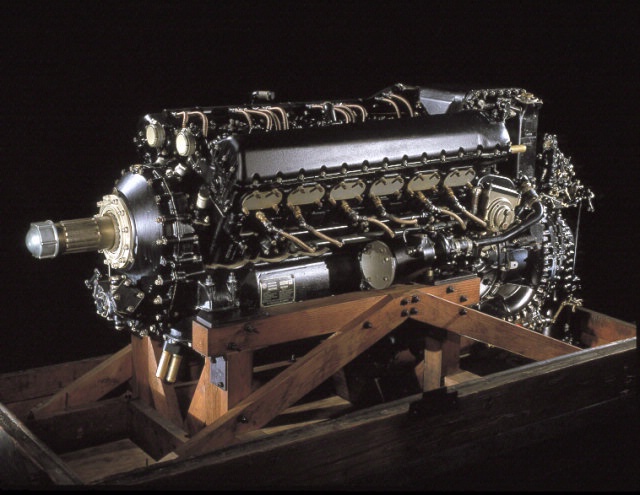
Object Details
Manufacturer
Mitsubishi Jukogyo K. K.
Physical Description
Type: Reciprocating, 18 cylinders, 2 rows, radial, air-cooled, turbosupercharged
Power rating: 1,641 kW (2,200 hp) at 2,900 rpm
Displacement: 41.7 L (2,546 cu in.)
Bore and Stroke: 140 mm (5.5 in.) x 150 mm (5.9 in.)
Weight: 980 kg (2,161 lb)
Summary
This Japanese engine incorporated fuel injection, fan cooling, and turbo-supercharging. Mitsubishi began development in 1941, and 16 engines were known to have been built during World War II. The engine powered several prototype aircraft including the: Mitsubishi Ki-83 Army Experimental Long-range Fighter; Tachikawa Ki-70 Army Experimental Command Reconnaissance Plane(Allied Code Name Clara); Tachikawa Ki-74 Army Experimental Long Range Bomber(Allied Code Name Patsy); Mitsubishi A7M3-J Navy Experimental 17-Shi Ko (A) Type Carrier Fighter Reppu (Allied Code Name Sam). None became operational, and the engines, which were not fully developed, proved unreliable during flight tests.
The Tachikawa Ki-70 was intended as a reconnaissance aircraft, but its performance fell below that of advanced versions of its predecessor, being overweight and the Ha-211 engine being unreliable. The Tachikawa Ki-74 was to be capable of bombing the United States mainland. However, the unreliable Ha-211 engines suffered from development problems, and the war ended before replacement engines could be tested.
Credit Line
Transferred from the U.S. Army Air Forces
Date
Circa World War II
Inventory Number
A19670082000
Restrictions & Rights
Usage conditions apply
Type
PROPULSION-Reciprocating & Rotary
Materials
Non-Magnetic Metal (Possibly Aluminum)
Ferrous Alloy
Paint
Unidentified Coating
Plastic
Paper
Tape
Copper Wire
Dimensions
3-D: 200.7 × 128.9cm, 444.5kg (6 ft. 7 in. × 4 ft. 2 3/4 in., 980lb.)
Country of Origin
Japan
See more items in
National Air and Space Museum Collection
Data Source
National Air and Space Museum
Link to Original Record
Record ID
nasm_A19670082000