
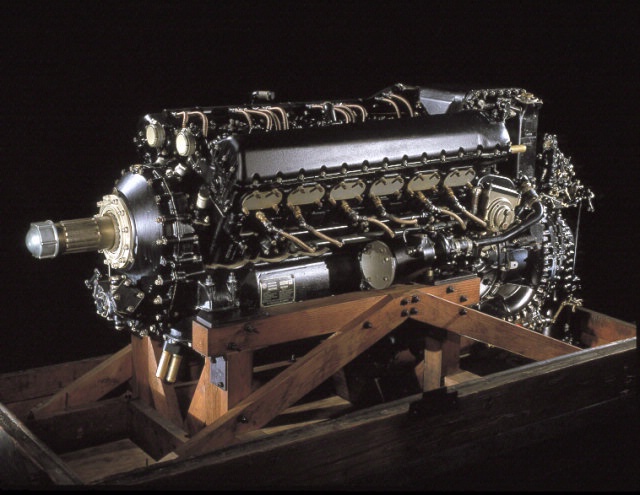
Object Details
Manufacturer
Lycoming (Williamsport, Pennsylvania)
Physical Description
Type: Reciprocating, Radial, 36 cylinders, nine 4-cylinder banks, liquid cooled
Power rating: 3,729 kW (5,000 hp) at 2,600 rpm
Displacement: 127 L (7,755 cu in)
Bore and Stroke: 162 mm (6.375 in.) x 171 mm (6.750 in.)
Weight: 2,783 kg (6,130 lb)
Summary
The XR-7755-3 is the largest, most powerful reciprocating aircraft engine in the world. During World War II, the U.S. Army Air Forces requested an engine with high takeoff power and low fuel consumption for a yet-to-be designed long-range bomber and transport. Lycoming began designing the engine in early 1944, and it was ready for testing by mid-1946. It featured nine dual-lobe overhead camshafts, which shifted axially for takeoff and cruising efficiency, and a two-speed, geared, dual-rotation propeller drive.
Lycoming built two XR 7755-3 prototypes. The company and the Army successfully tested them, but neither engine ever flew in an airframe. The proven reliability of the new gas turbine engines introduced after World War II made the XR 7755-3 obsolete before it could be fully developed. This artifact is the sole survivor.
Credit Line
Transferred from the U.S. Air Force Museum
Date
1945
Inventory Number
A19781379000
Restrictions & Rights
Usage conditions apply
Type
PROPULSION-Reciprocating & Rotary
Dimensions
Diameter 154.9 cm (61 in.), Length 308.2 cm (121.35 in.)
Country of Origin
United States of America
See more items in
National Air and Space Museum Collection
Location
Steven F. Udvar-Hazy Center in Chantilly, VA
Hangar
Boeing Aviation Hangar
Data Source
National Air and Space Museum
Link to Original Record
Record ID
nasm_A19781379000