
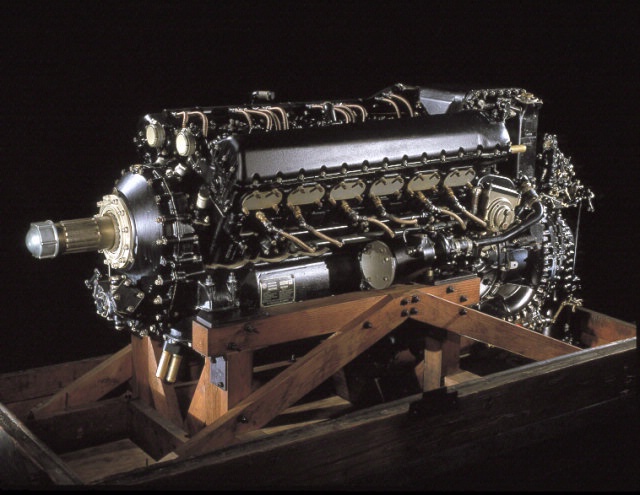
Object Details
Manufacturer
Lycoming (Stratford, Connecticut)
Physical Description
Type: Turbofan
Thrust: 19,224 N (4,320 lb) at 19,280 rpm
Fan: Bypass ratio 6:1, single stage
Compressor: Single-stage fan, 7-stage axial, 1-stage centrifugal
Combustor: Annular reverse flow
Turbine: Single-stage core, 2-stage free power turbine driving fan
Weight: 374 kg (825 lb)
Summary
The PLF1A-2 was the first high bypass (6:1 bypass ratio) fan engine run in North America. Lycoming's high bypass fan engine concept evolved from a 1950s series of conceptual studies directed to better compete with turboprops. By 1962, prototype design had begun utilizing the Lycoming T55-L-7 turboshaft as the engine core. Considerable feasibility tests were conducted in both private and government facilities in 1964 and 1965, and a window of opportunity opened with the early-1970s Air Force AX competition.
Derived from the PLF1A, Lycoming's YF102-LD-100 engine for the Northrop A-9 close combat aircraft performed very well during aircraft testing, although the Fairchild A-10 was selected in the fly-off competition. Lycoming later redirected efforts toward the commercial market with the ALF502D version of the YF102, which was successfully applied to the Canadair Challenger CL600 executive jet and British Aerospace BAe 146 commercial jetliner.
This PLF1A-2 was one of two prototype development engines, but never flew.
Credit Line
Gift of Textron Lycoming
Date
1964
Inventory Number
A19890042000
Restrictions & Rights
Usage conditions apply
Type
PROPULSION-Turbines (Jet)
Dimensions
Length 168.3 cm (66.277 in.), Diameter 103.3 cm (40.68 in.)
Country of Origin
United States of America
See more items in
National Air and Space Museum Collection
Location
Steven F. Udvar-Hazy Center in Chantilly, VA
Hangar
Boeing Aviation Hangar
Data Source
National Air and Space Museum
Link to Original Record
Record ID
nasm_A19890042000