
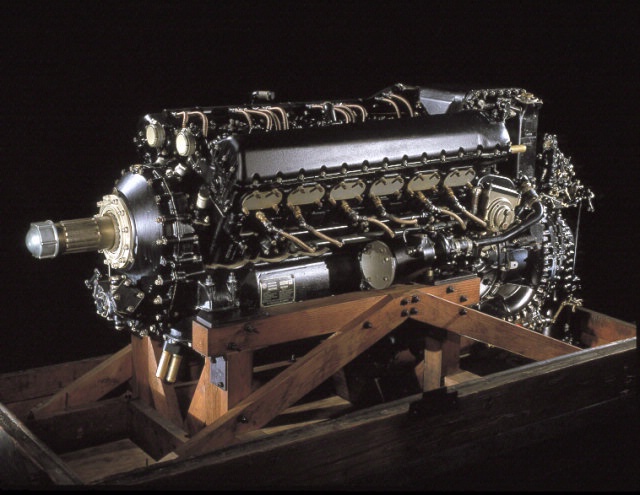
Object Details
Manufacturer
Bussing-NAG Entwicklungsgesellshaft G.m.b. H.
Designer
Dr. Otto Lutz
Physical Description
Type: Reciprocating, 6 cylinders, liquid cooled
Power rating: 298 kW (400 hp) at 800 rpm
Displacement: Not available
Bore and Stroke: Not available
Weight: Not available)
Summary
German researcher Otto Lutz introduced the swing-piston concept about 1923. Intended primarily as a high pressure compressor or gas generator for relatively high power gas turbine engines for long-range transport aircraft, principal advantages were improved fuel economy, use of Diesel fuel, and a compact design.
To reduce the space occupied by conventional reciprocating engines, cylinders were located inside a liquid-cooled annulus, and were the spaces between members of two sets of piston. Pistons were free floating and, instead of driving connect rods and a crankshaft as in conventional engines, generated compressed and heated gases by recoiling between cushions of charged air, with combustion at the time of maximum compression of each charge. Combustion products either passed directly through a discharge nozzle, furnishing jet propulsion, or through a turbine, to generate power for a propeller or ducted fan.
Two experimental units were briefly tested, but no substantiating data generated. An Allied bombing raid on the plant ended development.
Credit Line
Transferred From USAAF Technical Museum, WPAFB
Date
Circa World War II
Inventory Number
A19670099000
Restrictions & Rights
Usage conditions apply
Type
PROPULSION-Reciprocating & Rotary
Materials
Steel
Wood
Paint
Plastic
Adhesive
Cork
Fabric
Paper
String
Cadmium Plating
Copper Alloy Plating
Dimensions
Length 97.8 cm (38.5 in.), Width 94.6 cm (37.25 in.), Height 143.5 cm (56.5 in.)
Country of Origin
Germany
See more items in
National Air and Space Museum Collection
Data Source
National Air and Space Museum
Link to Original Record
Record ID
nasm_A19670099000