Object Details
Manufacturer
Jet Propulsion Laboratory, California Institute of Technology
Summary
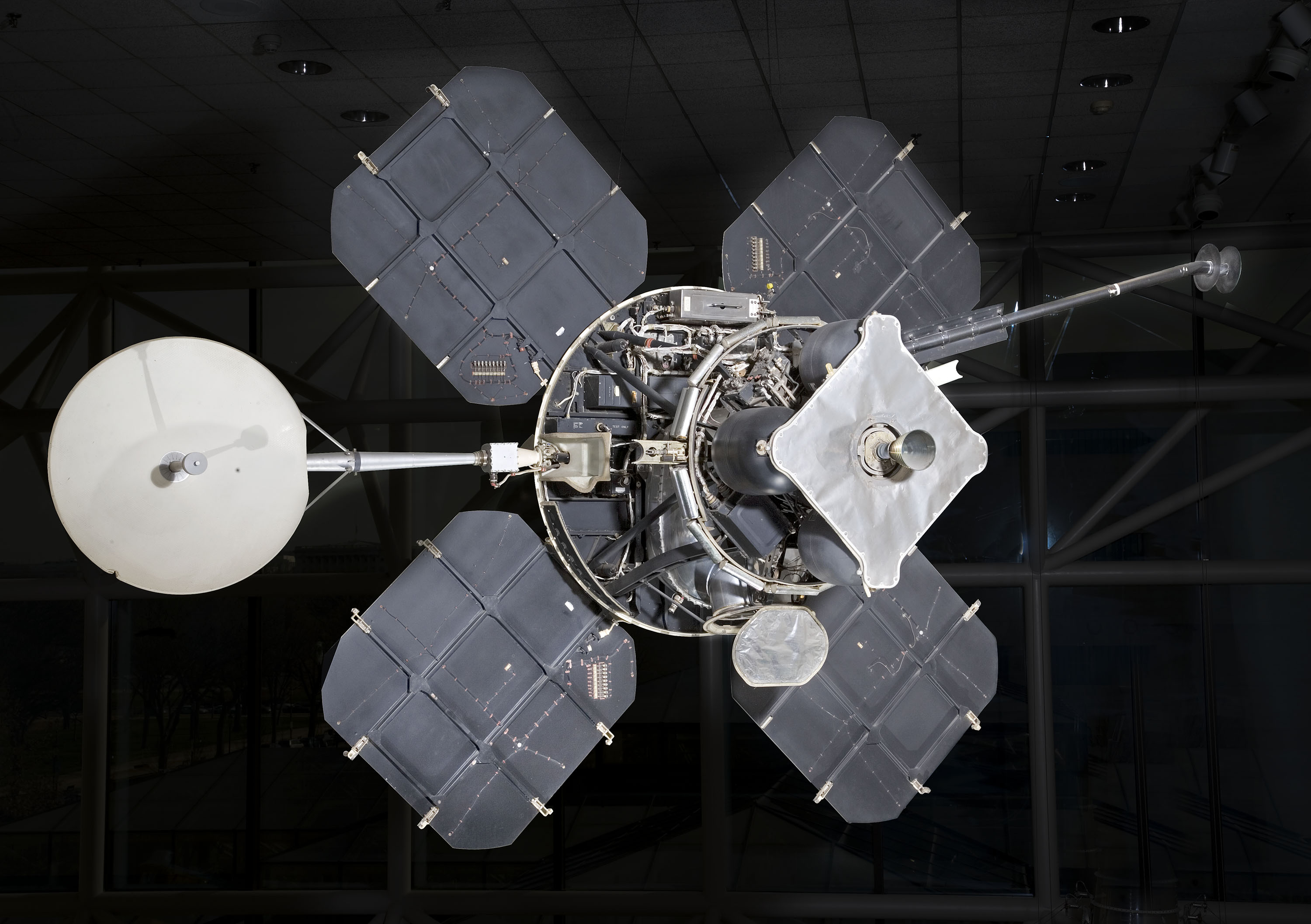
The Ranger spacecraft gave scientists their first close look at the lunar surface. Nine Rangers were launched from 1961 through 1965. The first six attempts failed, but beginning in July 1964, Rangers 7, 8, and 9 successfully completed their 65-hour journeys to the Moon by transmitting television pictures of the lunar surface during the final minutes until their impact there. These pictures revealed details that could not be seen through telescopes on Earth. Each Ranger spacecraft had six cameras on board. The cameras were fundamentally the same with differences in exposure times, fields of view, lenses, and scan rates. The images provided better resolution than was available from Earth-based views by a factor of 1,000. These highly detailed images aided Apollo planners in locating landing sites.
The spacecraft on exhibit is a replica of the final four Ranger spacecraft. It is made of parts from Ranger test vehicles and was transferred from NASA to the Museum in 1977.
Long Description
Ranger
Project Ranger was quickly initiated in 1959 during the Space Race with the Soviet Union to demonstrate that the United States could achieve feats in space comparable to those of the Soviets. In response to the Soviet's challenge after that nation placed Sputnik 1, the first artificial satellite into orbit, William H. Pickering, the Director of the Jet Propulsion Laboratory in Pasadena, California, suggested that the United States trump the Russians by sending a spacecraft to the moon. Ranger spacecraft were to carry scientific instruments and television cameras to gather information about the Moon before crashing into it.
In 1961, President John F. Kennedy committed the United States to "the goal, before this decade is out, of landing a man on the Moon and returning him safely to Earth." As a result, NASA developed a variety of lunar exploration spacecraft to take photographs of and map the Moon's surface in an effort to find a suitable landing site for future manned missions. Consequently, the science program now had a dual purpose: to scout for landing sites for Apollo astronauts and to gather new information about the Moon.
The Ranger spacecraft gave Americans their first look at the Moon from close range. Nine Rangers were launched using Atlas Agena B boosters from 1961 through 1965. The pressures of competition and a rushed development contributed to the failure of the first six Ranger missions. NASA took stock of the situation, redefined how it managed the program with a stronger emphasis on solid engineering, and redesigned the spacecraft to eliminate all but the television camera system. As a result, Rangers 7, 8, and 9 successfully transmitted more than 17,000 television pictures of the lunar surface. Each Ranger spacecraft carried 6 cameras that were essentially. They only differed in exposure times, fields of view, lenses, and scan rates. The camera system was divided into two channels, F (full) with a single wide angle and narrow angle camera, and P (partial) with two wide angle and two narrow angle cameras. Both channels had separate power supplies, timers, and transmitters. The F-channel image returned images from as close as 5 kilometers above the Moon while the P-channel did so from as low as 600 meters - just 0.2 seconds before impact. The photos enabled NASA to make highly detailed maps as well as three dimensional representations of the lunar surface. The images were 1000 times better than those available from existing Earth-based telescopes. Craters as small as one meter in diameter and geological evidence of volcanism were seen for the first time. During the last mission, the pictures were broadcast live on network television, enabling millions of viewers to witness a descent to the Moon.
The Deep Space Network that was created to track the progress of each Ranger flight provided invaluable scientific data on the dimensions and composition of the Moon for the first time. Because of Ranger, NASA gained experience in computing trajectories much more accurately in large part due to the development of a sophisticated two-way doppler tracking and communications system that could measure the velocity between the spacecraft and NASA's Deep Space Network tracking stations. Furthermore, the Ranger program helped NASA pioneer technologies in the design and construction of future robotic spacecraft intended for the exploration of deep space. In particular, attitude stabilization on three axes, onboard computers, and a steerable high-gain antenna. An important spin-off to the civilian market involved digital computer image enhancement through the development of techniques to remove noise from Ranger's picture signal and to enhance contrasts in the photographs of the lunar surface. The technique proved immediately useful in the enhancement of X-ray photographs providing doctors with much more accurate images of patients' skeletal structure.
Ranger was a critical step in the development of America's robotics spacecraft as well as being instrumental in the creation of a viable communications network. It also enhanced managerial techniques that proved invaluable in America's successful attempt to reach the Moon and into deep space.
SPECIFICATIONS:
Height: 3.1 m (10 ft 3 in)
Span: 4.6 m (15 ft)
Weight: 366 kg (809 lb)
Manufacturer: Jet Propulsion Laboratory; Launch vehicle: Atlas-Agena B
Alternate Name
Ranger Spacecraft
Key Accomplishment(s)
First Close-up Views of the Lunar Surface
Brief Description
The Ranger program was a series of spacecraft launched from 1961 through 1965 to return closeup images of the lunar surface. Rangers 7, 8, and 9 reached the Moon and transmitted television pictures of the lunar surface until they were destroyed on impact.
Credit Line
Transferred from the National Aeronautics and Space Administration
Inventory Number
A19770993000
Restrictions & Rights
Usage conditions apply
Type
SPACECRAFT-Uncrewed
Materials
Metal, plastic, assorted composites.
Dimensions
Overall: 10 ft. 3 in. tall x 15 ft. wide, 784.2 lb. (312.42 x 457.2cm, 355.7kg)
Country of Origin
United States of America
See more items in
National Air and Space Museum Collection
Location
National Air and Space Museum in Washington, DC
Exhibition
Destination Moon
Data Source
National Air and Space Museum
Link to Original Record
Record ID
nasm_A19770993000