Skip to main content Skip to main navigation
heart-solid My Visit Donate
Home Smithsonian Institution IK development site for ODI
Press Enter to activate a submenu, down arrow to access the items and Escape to close the submenu.
    • Overview
    • Museums and Zoo
    • Entry and Guidelines
    • Museum Maps
    • Dine and Shop
    • Accessibility
    • Visiting with Kids
    • Group Visits
    • Overview
    • Exhibitions
    • Online Events
    • All Events
    • IMAX & Planetarium
    • Overview
    • Topics
    • Collections
    • Research Resources
    • Stories
    • Podcasts
    • Overview
    • For Caregivers
    • For Educators
    • For Students
    • For Academics
    • For Lifelong Learners
    • Overview
    • Become a Member
    • Renew Membership
    • Make a Gift
    • Volunteer
    • Overview
    • Our Organization
    • Our Leadership
    • Reports and Plans
    • Newsdesk
heart-solid My Visit Donate

Lunar Module #2, Apollo

Air and Space Museum

This media is in the public domain (free of copyright restrictions). You can copy, modify, and distribute this work without contacting the Smithsonian. For more information, visit the Smithsonian's Open Access page.
International media Interoperability Framework
IIIF provides researchers rich metadata and media viewing options for comparison of works across cultural heritage collections. Visit the IIIF page to learn more.
View manifest View in Mirador Viewer

    Object Details

    Manufacturer

    Grumman Aircraft Engineering Corporation

    Summary

    The Apollo Lunar Module (LM) was a two-stage vehicle designed by Grumman to ferry two astronauts from lunar orbit to the lunar surface and back. The upper ascent stage consisted of a pressurized crew compartment, equipment areas, and an ascent rocket engine. The lower descent stage had the landing gear and contained the descent rocket engine and lunar surface experiments.
    LM-2 was built for a second uncrewed Earth-orbit test flight. Because the test flight of LM 1, performed as part of the Apollo 5 mission, was so successful, a second unmanned LM test mission was deemed unnecessary. LM-2 was used for ground testing prior to the first successful Moon-landing mission. In 1970 the ascent stage of LM-2 spent several months on display at the "Expo '70" in Osaka, Japan. When it returned to the United States, it was reunited with its descent stage, modified to appear like the Apollo 11 Lunar Module "Eagle," and transferred to the Smithsonian for display.

    Alternate Name

    Lunar Module LM-2

    Key Accomplishment(s)

    Landed Astronauts on the Moon

    Impact or Innovation

    This lunar module represents one of humanity’s greatest achievements: landing people on another heavenly body.

    Brief Description

    Between 1969 and 1972, six lunar modules identical to this one landed a total of 12 American astronauts on the Moon. This lunar module, LM-2, never flew in space. It is configured as LM-5, Apollo 11’s lunar module Eagle.

    Credit Line

    Transferred from the National Aeronautics and Space Administration

    Inventory Number

    A19711598000

    Restrictions & Rights

    CC0

    Type

    SPACECRAFT-Crewed-Test Vehicles

    Materials

    Aluminum, titanium, aluminized Mylar and aluminized Kapton blankets

    Dimensions

    Overall: 21 ft. 5 1/2 in. × 21 ft. 5 1/2 in., 8499.9lb. (654 × 654cm, 3855.5kg)

    Country of Origin

    United States of America

    See more items in

    National Air and Space Museum Collection

    Location

    National Air and Space Museum in Washington, DC

    Exhibition

    Boeing Milestones of Flight Hall

    Data Source

    National Air and Space Museum

    Metadata Usage

    CC0

    Link to Original Record

    http://n2t.net/ark:/65665/nv950f30cee-381e-4341-ad61-757e6416e7ac

    Record ID

    nasm_A19711598000

    Discover More

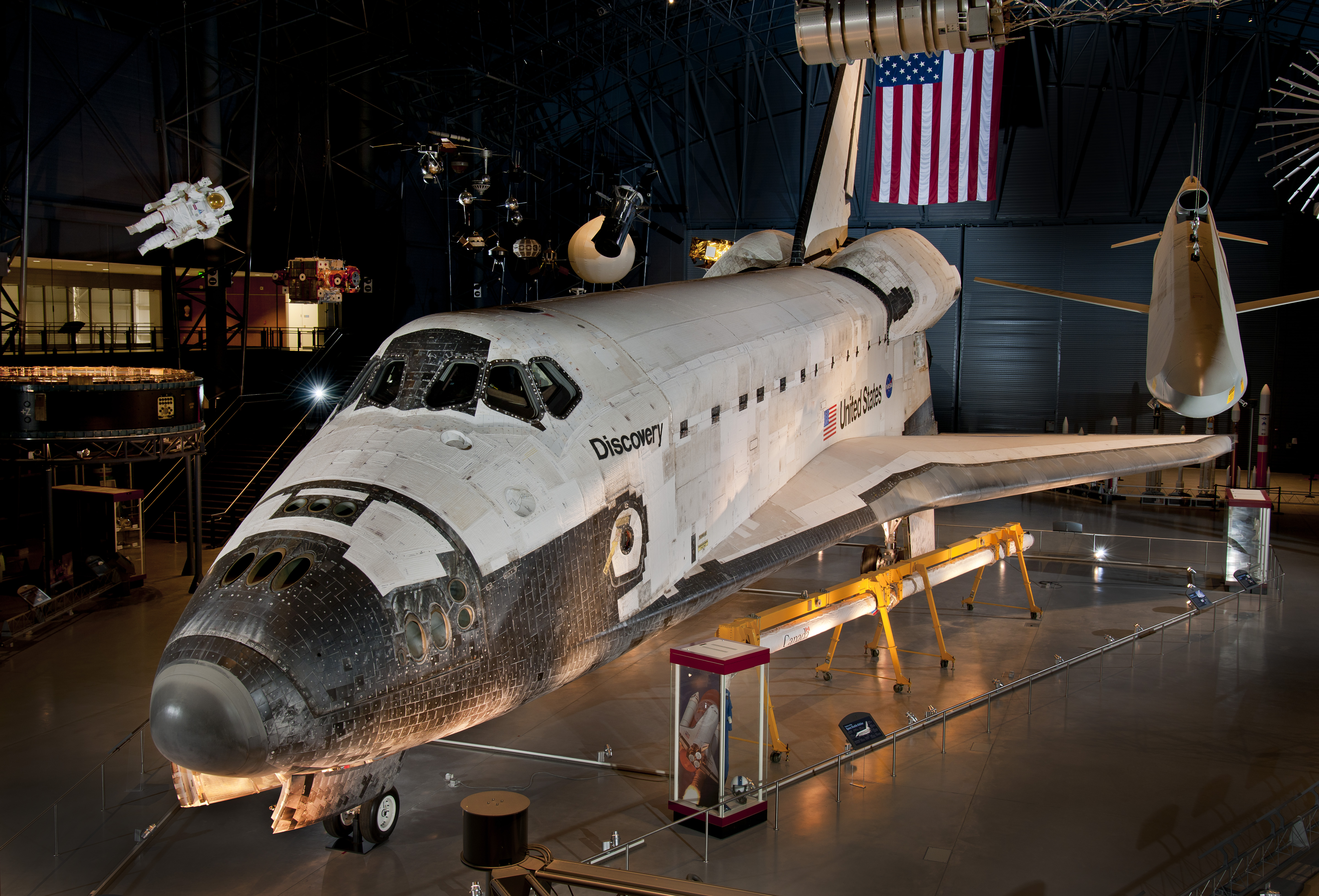
    Space Shuttle orbiter Discovery on display in the McDonnell Space Hangar at the Steven F. Udvar-Hazy Center

    Human Spaceflight

    Space Shuttle orbiter Discovery on display in the McDonnell Space Hangar at the Steven F. Udvar-Hazy Center

    Human Spaceflight

    arrow-up Back to top
    Home
    • Facebook facebook
    • Instagram instagram
    • LinkedIn linkedin
    • YouTube youtube

    • Contact Us
    • Get Involved
    • Shop Online
    • Job Opportunities
    • Equal Opportunity
    • Inspector General
    • Records Requests
    • Accessibility
    • Host Your Event
    • Press Room
    • Privacy
    • Terms of Use